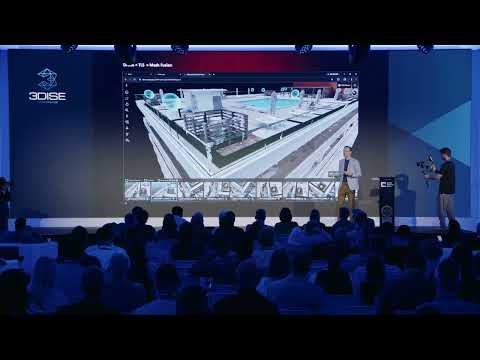

Barry Bassnett of RICHPiX looks at what changed in spatial imagery over the past year: global shutter cameras that remove the limits of rolling shutters, and OpenUSD as a way to make huge point clouds, meshes and splats findable, layered and collaborative. Barry shows how USD variant sets and lazy loading are used in the Shackleton project at the Stromness whaling station villa and argues that storytelling is what makes 3D data useful.
“Now, a vibrating tripod in a camera is a killer for photogrammetry, but not anymore.”
“And the reason that they're doing that is because it's basically is the HTML of 3D.”
“We are on the verge of a massive, massive explosion in our technology, and I don't think people realize just how big it is.”
According to Barry Bassnett, a global shutter removes the pixel smearing of rolling shutters, so images can be captured from moving vehicles, on vibrating platforms, as fast RAW sequences and with less atmospheric shimmer at long range.
Barry described OpenUSD as an open source framework from Pixar that acts as a universal bridge between formats such as point clouds, meshes, Revit and IFC models, and predicted that everyone will be talking about it at next year's conference.
Barry said companies long wanted to protect their own intellectual property, but now all the big players are at the table, driven by NVIDIA Omniverse being powered by USD.
Transcribed automatically (ElevenLabs Scribe) and lightly edited. It may contain small errors. Click a time to play the video from there.
Barry Bassnett: All right. Uh, hi everyone, um, it's lovely to be here again. It's a year since I was here. Um, and, uh, I don't know about you, but I've been really busy. Hope you have too.
Barry Bassnett: Uh, it's been an amazing year when you look at what technology has arrived. The Gaussian splat has exploded, um, and we've got all sorts of different ways of delivering things. Now, I'm a-- my business is RICHPiX. This is what I do, but basically what I work in is spatial imagery. I started life as a very small photogrammetrist, but now it's expanded, and it's about what will you do with a camera, um, to inf- to share our world, um, whether that's photogrammetry or taking images to produce Gaussian splats or tagging images or colorizing point clouds.
Barry Bassnett: My thing is really what I, I look at the camera. That's my, that's what I look at. And, and I'm gonna share what I, the sort of the little journey over the last year that I think has been significant to me, and I hope it's gonna be significant to you or maybe introduce you to a few subjects which maybe you didn't know you didn't know. Um, so I'm gonna talk a bit about hardware first. So the, in the, oh.
Barry Bassnett: So the hardware. So I've been playing about with, um, a new camera. It's called the Sony A9 III. And this has changed the way I think about photogrammetry. Um, it's pushing us into areas that I've not been able to do before because it's the first full-frame camera with what we call a global shutter.
Barry Bassnett: What that essentially means is I can sync flash to an eightieth thousandth of a second. So suddenly I can do photogrammetry of a bullet passing through. Now, what does that mean to you and me? Well, photogrammetry sometimes gets into difficult situations. If I wanna do photogrammetry of, say, a tunnel or a road, and I wanna mount it on a vehicle, well, what we get quite often with the rolling shutter is this pixel smearing.
Barry Bassnett: With this, we can eliminate it. Or I might wanna put it onto a... Excuse me while I get there. So I might wanna put it onto a, a, a project where things are vibrating, like an oil platform. Now, a vibrating tripod in a camera is a killer for photogrammetry, but not anymore.
Barry Bassnett: And there's sort of six things that are improving with photogrammetry with this particular camera, and I think it's the first of a whole new series of cameras that we're gonna get. The first is speed of capture 'cause now I can put this on a camera on a vehicle, and I can scan at fifty kilometers an hour with no pixel smearing at all. Which might not sound too go-- um, too interesting, but if I'm doing tunnel inspection, it's really interesting. Object movement is the objects might be moving or vibrating. I can also shoot at a hundred and twenty frames per second in RAW.
Barry Bassnett: Okay, now a lot of the workflows that we've got these days use video, and the problem with video, it uses a rolling shutter. So if I move, I do get a degradation. I get a hundred and twenty frames in RAW static imagery, which doesn't sound that exciting, but for me it really is, and I'm a geek. So it's, uh... The other issue that we get is if we want to do long range photogrammetry because we have to shoot through the atmosphere.
Barry Bassnett: And the atmosphere, like on a hot day like today, shimmers. We get a thing called scintillation. We also get scintillation from satellite imagery too. It's another story. But this negates that.
Barry Bassnett: We get noise reduction, and we get an increase in resolution. And y-- that's a little bit about the hardware which we are gonna see over the next few years in photogrammetry, which is gonna change the way we think about things. But on the other side of things, I, I spent my life, I started life as a cartographer, and what I see is all these fabulous technologies, but I see a thing called the, well, I call the atlas problem. The atlas problem for me is about I can put an atlas on a coffee table, or I can put a point cloud or a mesh, but it only becomes useful if I've got an index at the back, so I can find what I'm looking for. And one of the problems that we have in our sector is we produce these massive point clouds, but we can't find anything.
Barry Bassnett: It's great to look at. It's great for familiarization. But what do we use this for? And the same applies whether it's a point cloud or a Gaussian splat. And in order for us to do things, what one-- we really need to look at three things, I think.
Barry Bassnett: Findability. How do I find Dead Beaver Creek or Billygoats Gruff or whatever it might be in my atlas or my point cloud? The other thing that atlases are very good at is, is delivering relevancy in layers. So I can have a map of Czech, Czech Republic or the UK, and I can look at the rivers and the forests and the mountains, or I can look at the political boundaries. The point about it is the data we're providing is relevant to different people at different times in different ways.
Barry Bassnett: And the other thing I wanna be able to do is I wanna be able to collaborate. I just don't want to send people a point cloud, and it just sits there like a three-D postcard. I want people to contribute to it. And more importantly, if I'm a digital twin person, what I really wanna do is be able to update it 'cause otherwise it's just a historic document. I need to be able to collaborate and update things.
Barry Bassnett: So I'm gonna introduce you to those people who don't know about this. There's a thing called the OpenUSD, Universal Scene Descriptors. Can I have a quick show of hands? How many people know what I'm talking about? Oh, that's great.
Barry Bassnett: There's only a few of you. Brilliant. Okay, so OpenUSD has been around for a few years, and anybody who follows me on LinkedIn, um, will know I've been writing about this for about three or four years. OpenUSD was invented by Pixar, um, to manage the digital assets in their films. So every strand of hair on the prince's head is an object.
Barry Bassnett: But what they need to be able to do is collaborate on those things. What happened, they gave that to the planet, um, and a number of companies you might have heard of, NVIDIA, Apple, Adobe, Bentley, Esri, uh, who else? Uh, pretty well everyone, have all got together in one room. And the reason that they're doing that is because it's basically is the HTML of 3D. If I've got a website or webpage, what it does is it aggregates information, text from here, photograph from here, uh, photograph a SQL and a SQL query for a database in there.
Barry Bassnett: And that's what this does. It provides us with what we call universal interoperability. Um, acts like a, a universal bridge. So you don't have to worry about having to do things in a different format anymore. It just allows all these different formats to talk to one another.
Barry Bassnett: Um, allows us to share point clouds. It allows us to share mesh models, capsules, real-time game engines, all sorts of different things. And the in- interesting thing it is, and the reason why people like NVIDIA are involved in it, is because it provides a massive scalability, almost infinite, with bits built to manage millions and millions of objects, uh, with a sort of zero latency. So it's basically is a universal translator. So what we can do is we can use this in heritage or in our infrastructure projects where we're often dealing with digital silos.
Barry Bassnett: We have this point cloud, and we have this Revit model, and we have this, uh, IFC model. They're all different silos, but how do they all talk to one another? OpenUSD provides it and fixes this problem. It's not just a file format. It's a powerful open source framework.
Barry Bassnett: It's developed by Pixar really to manage all these millions of assets when you get into a film. Um, but it can be used and is being used by lots of people to build digital twins. I'll let you read all that anyway because you, you got the slides later on. But the real value for me is that it allows us to provide what we call variance. A variance means I can have one file, and with a very little effort, I can change it to do something else.
Barry Bassnett: Its core capabilities, it's non-destructive. Um, I can edit, curate it, do whatever I like with it, but I'm not gonna kill it. The variance sets, as I'm just gonna show you in a second, allows me to do different things. So I can show a variance of something taken today and then a variance of something that was taken two years ago, all in the same file format, all in the same environment without having to change it. Because the normal way you would do it is I'd have to produce a mesh model of something in one condition and a mesh model in another condition, and then upload those.
Barry Bassnett: But the real, I think the real thing is, is allowing live collaboration as well. What does that mean? Well, for example, what I can do if in heritage or say this was a crack, photogrammetry normally likes us to use flat lighting, which is great. We get the normal universal color of the, of the correct color. But sometimes we wanna use a thing called raking lighting, which shows the tool marks and the cracks.
Barry Bassnett: Now, I've got normally correct, come to deliver two different photogrammetry models of this, but with USDs, I don't have to do that anymore. Okay. It's one asset and many, many stories. The variance set allows us to look and compare things, and there's just thousands of use cases that we can talk about. Um, the efficiency really is, is I don't need to have five different files.
Barry Bassnett: Now, you're probably wondering, "How is this gonna impact me?" I would suggest that this time next year when you're having a conference, everyone's gonna be talking about OpenUSD as a way that we can share information. So you're gonna need to learn some new languages if you don't, some new words if you don't know this. Introducing LIVRPS. Now, the good news for you is this is pronounced liver piss.
Barry Bassnett: Okay? So you're able to share this with your kids and go, "I've been working on liver piss today," and they'll be able to laugh. Okay? Because you're not swearing, but it is pronounced liver piss. And there's some things you need to remember or some words you need to know.
Barry Bassnett: The prims, this is like the fundamental objects that we're working with. Um, layers. So we can deliver information in different layers. Remember the atlas and the physical map and the political map. Allow, allow- allowing us to deliver in layers allow us to deliver relevancy to the user.
Barry Bassnett: If I come into a building as a f- as a fireman, I don't wanna know what the carpet is. I do wanna know where the safety shut-off valve is. That's relevancy. That's about putting our data to use. Um, we also have a stage, and the stage isn't like this.
Barry Bassnett: But a stage is the platform where we can bring different things in, um, change things, change configurations. And it's not really much surprise when you think about the digital twin industry largely dominated by NVIDIA. Their platform, Omniverse, is powered by USD built on a stage. And the other thing is it allows for payload. It allows us what we call lazy loading.
Barry Bassnett: We don't have to worry too much about the performance. We're only loading what's visible And this comes into one of the big problems we have as a sector. If I wanna do a big digital scan of a building, I've gotta go and upload all the mesh model. With USDs, you don't. You only down- upload what you need in different formats.
Barry Bassnett: So it could be, for example, I've got a, a, a building but a plant room. I could have it in one level, but then I could have the plant room at another level of definition, and I can have the plant, the pump or whatever it is, the critical piece of machinery, in a me- in a metrology level, down to a p- a millimeter or less, and simulate what's going on, all in the same environment. Okay. So, um, we're actually using this in a thing called the Shackleton project. Um, so I've been working on, like, six and a half continents this year in different projects.
Barry Bassnett: And the reason it's six and a half is because it's there. It's right down the bottom. This is part of, uh, it's part of the British Antarctic Survey, so I'm sort of claiming Antarctic continent for the work. The story is, uh, from Shackleton the explorer. His boat sank, and he navigated and saved his people and was rescued by this whaling station.
Barry Bassnett: And we're constructing a three-sixty model of this because, to be honest, the only people there are penguins. And this was great. For the first risk assessment I've ever done, we had to put elephant seals in here, which are massive, great big things. We're not allowed to camp on there 'cause they roll over. This whole place is not very accessible, and we...
Barry Bassnett: But some people, lovely Norwegian timber people and carpenters, have refurbished what's called the Villa, which is where Shackleton came over the mountains, knocked on the door, opened it, said, "My name's Shackleton," and everybody burst into tears 'cause they thought he was dead. But this is gonna-- this is what we're trying to do, but we're trying to build this using USDs. And the reason we're doing that... Okay. So the-- Oh, yeah.
Barry Bassnett: So this is my crew who are surveying down there. We're using photogrammetry. We're using mobile scanner. And the reason I'd like this is because all this area is contaminated with asbestos. Okay.
Barry Bassnett: So we can't-- the tourists can't go there, but we need to share this and story. And we're actually working for a, a film production crew to develop a three-D model of this. But that's not the interesting thing. The interesting thing is that we're able to use USDs. So we are going out and scanning.
Barry Bassnett: So we built the model of the villa, but what was in it at the time? So what we're doing is going around different museums and scanning the artifacts, converting them into USDs, and then we're going to, um, upload all that, and people can view it. Okay? So I'm just gonna tell you. So th- this picture here.
Barry Bassnett: So what we're able to do with USDs is the Stromness Villa on th- this one here, is we can s- we can actually... We've got it scanned in the, the, um, restored state, but we'll be able to skim back to what it was in the derelict state, but we'll also be able to add different bits in there, like the bath and the table and the chair, which have been scattered to the four winds in different, in different museums all over the place. Um, and I'm working on another project, um, and this is, um... Hopefully, this'll work. Yeah, it will.
Barry Bassnett: Um, this is from Mike Deavers, who's done this. This is a Gaussian splat. And this is just to show the sort of thing we wanna be able to do. This is, um... Thomas Brassey was, uh, one of the most unfamous engineers.
Barry Bassnett: At one point in the world, he made a twentieth of, one in twenty of all the miles of railway line that were built. No one knows about him. But using AI, Mike's been able to actually show us what it was like. And this is from a Gaussian splat with a bit of AI. Visa skies are you in?
Barry Bassnett: I think they probably used you for that. But this is about engagement. This is about telling a story. It's not just about a plant. It's not just about that.
Barry Bassnett: That's what it... This is outside my hometown in Chester. And interestingly, he was a land surveyor who was born and built his factory two hundred yards from me. Okay. It's about storytelling, I think.
Barry Bassnett: What we do is all about storytelling. Is it storytelling about the, the, um, history or storytelling about the history of the maintenance of my plant, my oil platform, my hospital, my building? USDs provide us with a tool that takes us to another level of engagement and collaboration. Um, project I was working on last year, um, if you wanna... And this is to do with another aspect of what we call digital asset management.
Barry Bassnett: Um, if you wanna take a photograph of that, you will be able to see this temple in this room. Okay? Don't do it... You can do it later on or take, take a... Just take a photograph.
Barry Bassnett: Don't do it right now 'cause I'm talking, but I know you'd get all excited. But this is a Gaussian... This is a model which is a USD version. I call it USDZ. And it's managed by a digital asset management software called VNTANA.
Barry Bassnett: And what the Met have done is they've taken a hundred objects, and they've scanned them to put them out there. And the great thing about the Met is they've been taking photographs for a hundred and twenty years. They know how to light things. I just worked with them last February, I think, January, February, helping them get the photogrammetry sorted. Um, but also you can have a look at digital asset management.
Barry Bassnett: If you wanna take a photograph of that, um, that's gonna bring a bit of industrial plant into the room, which you will be able to navigate. Again, it's an example of a USD. So I'd like to thank you for that bit, but then I've got a thank you for you guys. So I've been writing a book over the last year, um, about digital twins. And the issue I've got there really is if you want to write a book about digital twins, by the time the ink is dry, it's out of date.
Barry Bassnett: Things are moving on ever so quickly. So, um, this is a book. It's around a hundred pages of what I think, my views, my personal view. If you wanna disagree with it, absolutely fine. But it's about how human beings are gonna relate to the three-D world.
Barry Bassnett: How do we get this? How do we make it useful? How do we collaborate with it? Now, if you want a copy of this, there's a simple thing. Just send me your email, hit me up, and I'll send you a copy of it.
Barry Bassnett: But no, this is gonna be a subscription thing, okay? I'm not, I'm not gonna charge you for it, but, uh, I'm gonna have to add chapter after chapter and bring this up, and every month or so there's gonna be a new chapter. But if you'd like to go on there, that will take you to a page where you can get all sorts of information about what it is that I do. I try and share what I know about photogrammetry. I think I'm up to about one hundred and s- fifty tips on photogrammetry on LinkedIn now.
Barry Bassnett: I've got loads more. I'm gonna bore you for years with that. Okay? But also, uh, on that page you'll be able to link to my blog site where I've got over a hundred articles about photogrammetry and stuff. But I'd really like your impressions of what I've written here.
Barry Bassnett: This is about how we move and take this technology and make it much, much bigger than the CAD delivery or the GIS pilot or whatever it is. We are on the verge of a massive, massive explosion in our technology, and I don't think people realize just how big it is. Now, I think I might be the oldest person in the room, and I'm really excited. I'm never gonna retire because this stuff is so sexy. All right.
Barry Bassnett: So that's it for me. Um, I'm here till f- Thursday evening if you wanna hit me up. Um, oh, and also the other thing is, um, the Shackleton project, I'm not allowed to show it, but if you buy me a beer, I've got it on my phone. All right? So I'm think I'm gonna get very drunk later on.
Barry Bassnett: Uh, so that's m- for me. I hope to see you later on in the bar and talk about all things to do with digital capture and sharing and taking this off. This is such an exciting time for this industry. Um, I look forward to sharing the journey with you.
Host: Ladies and gentlemen, Barry Bassnett. Thank you so much, Barry. A couple of question, one or two.
Barry Bassnett: Mm-hmm. Yeah.
Host: Uh, we still have time.
Barry Bassnett: Okay. Cool.
Host: Um, USDs, they have existed for quite a few years.
Barry Bassnett: Yeah.
Host: Actually now. So why do you think they haven't been embraced as the universal file format yet?
Barry Bassnett: Largely, there's a number of reasons. Um, I think most people wanted to com- wanted to protect their own intellectual property, which is entirely un- believable. But what you've got now is you've got all the big players in the room. Uh, FOMO, fear of missing out. If they aren't able to work in USD, basically they're gonna be extinct, in my view.
Barry Bassnett: Now, that might be seen a bit dramatic to say, but in all my years, and there's a few, since I've been doing this since the Jurassic period, this is the first time I've seen all these people in the room at the same time talking. And the reason it's working is because of NVIDIA and Omniverse. It is powered by USD and everybody wants a piece of that action. Apple, Google, everyone.
Host: Let's give it up for Barry one more time, and let's give him a beer.
Barry Bassnett: Thank you.
Host: It's gonna be fun night.

Owner and founder of RICHPiX
A visionary geospatial expert with 40+ years in revolutionizing info management, spatial data capture, and applications. Inventor of the 32-bit photogrammetry method, I leverage tech like Immersive GIS and AI to advance reality capture for broader use.