

Barry Bassnett of RICHPiX, a photogrammetrist since the film era, argues that image quality is the core of every reality capture workflow, from photogrammetry and 360 imagery to point cloud colorization and Gaussian splats. Using a project documenting every decorated surface of Westminster Cathedral in London, Barry shows how bracketed HDR ("32-bit") imagery, colour calibration and de-lighting deal with extreme dynamic range, and why findable, consistent images matter.
“Now, it turns out that shadows are not quite as important as highlight. Sunshine is the thing that kills photogrammetry.”
“What they forget, it's the midtones, the contrast that make your models pop.”
“I think photography is gonna be the most single important skill that everybody in this room needs to master.”
Barry Bassnett uses bracketing: multiple exposures are aligned, merged into a 32-bit EXR file and tone-mapped, with batch processing so not every image has to be handled by hand.
According to Barry Bassnett, it means correct colour, sharp focus, controlled dynamic range, strong midtones and consistent lighting across all images.
Not always. At Westminster Cathedral, Barry Bassnett used calibrated HDR 360 imagery for inspection rather than a mesh model, while the lidar point cloud of the building served as control.
Transcribed automatically (ElevenLabs Scribe) and lightly edited. It may contain small errors. Click a time to play the video from there.
Barry Bassnett: Hi, guys. Wow. Uh, hasn't it been great so far? Um, I'm, I'm, um, um, sorry, Michal, you've been really mean, putting me, the oldest person, on last 'cause it's way past my nap time. Um, so I'm gonna be-- The t-the title of my thing is The Delight of, um, what it was, Delight of, um, Photogrammetry, and that is a play on words because what I'm gonna talk to is about the process of delighting.
Barry Bassnett: But also, this is just so much fun, you know? I f- I think we forget sometimes we have a fantastic job, and we get to play with amazing kit. And then you see displays like we've seen from our underwater friends and Nira and, and Ted's thing this morning that blew my mind about... Why can't we get Skydio in Europe, please? Anyway, that's another story.
Barry Bassnett: So I'm gonna be talking about, uh, well, I'm an advocate for cameras. That's why I've got one here. It doesn't have to be a fancy camera like this. It could be just my mobile phone, and we forget that these are fundamental tools for what we can do, and imagery is so much part of most of the workflows. So this is me.
Barry Bassnett: Um, okay, this is not me shrunk. This is a l- This is not Who Shrunk the Photogrammetrist, 'cause that's what I am. Most of my stuff is... That's my kit. I travel around the world now training people on photogrammetry.
Barry Bassnett: Well, that's what I try and do anyway. Um, I've been working in photogrammetry for, gosh, since the Jurassic period, I think. Um, I am an analog guy. I was the guy who used to take photographs with film, sit in the back of planes throwing up, take all my developing chemicals with me, make up a dark room in my hotel room or whatever shed I could find. But now we've got our digital stuff, and I've moved from training as a photogrammetrist to cartographer for ten years.
Barry Bassnett: And then I moved into industrial photogrammetry, where I worked on projects like the International Space Station and weapons systems alignment for jet fighters. Be- 'cause, 'cause the interesting thing is the same technology that you're using now has been used in industrial metrology for many years, and people are only discovering it. Um, oh, sorry, I've gone the wrong way. Okay, so I go out and do training. So I've just come back from, I was in New York at The Met, training people on how to-- They've been photographing for a hundred and twenty years, but they're now they're moving into threeD modeling.
Barry Bassnett: But they've got a fantastic imaging suite. But what I do is I, for the things that are too big to take into the imaging suite where you can control the lighting, I take that and teach them how to do, photograph big stuff. And the problem with photographing big stuff is, well, basically, you see in here, we've got all sorts of different sorts of lighting conditions. And what I do, and what I try to do, is if you look, look from the back, my thing, Shadow Buster, what I try and do is try and eliminate the shadows from imagery 'cause shadows hide data. Now, it turns out that shadows are not quite as important as highlight.
Barry Bassnett: Sunshine is the thing that kills photogrammetry. But what I try and do is show people how they can get around that. And this is the team from The Met. That's me in the middle, of course, looking svelte and young. Okay.
Barry Bassnett: Um, but we've got these guys have just, uh, they've been taking photographs for a hundred and twenty years. These are the best in the world. But we had a great time sharing experiences and moving things on and taking photographs. And what I wanna try and do is explain that that imagery is at the core of what we do. Um, in this case, it's just simple things like changing a color image to black and white can change the way that we look at a job, how we use it for inspection.
Barry Bassnett: But I'm gonna talk about a particular project. But first of all, I wanna do something and take and try and do something that no one's ever done before. So I'm a photogrammetrist, but I'd like to rebrand myself in my middle age, okay, my, the end of my career, into what I call spatial imagery. Because we're taking photographs, but we're using photographs in so many different ways nowadays. So we u- use it for photogrammetry, obviously, but photogrammetry can be drone-based, it can be terrestrial-based.
Barry Bassnett: We can take it from the satellite. We can take it from a drone. Um, we've also used threeSixty imagery. Much more has been talked about using threeSixty imagery. Um, we've got things...
Barry Bassnett: If I'm being honest, guys, I haven't really learnt much from the geomatics industry in the last ten years. Most of what I've learnt about processing imagery and making colors and calibrating and all sorts of things has come from the IBL, image-based lighting, film, and effects business. So I've been adapting those things for-- I invented a term called thirty-two-bit photogrammetry, which is, uh, I just, it was, it's really HDR, but everybody's hijacked that, so I wanted to change it to something. Um, we're using imagery in all sorts of geo-based, geotagged imagery, whether it's a camera with an RTK system or we're just walking around taking photographs of assets and stuff. Um, am I looking here?
Barry Bassnett: Okay. I've just seen the, I've just, there's a time clock here. Okay, I'm just... Fourteen. Okay, that's fine.
Barry Bassnett: And then we've got photogrammetry also about point cloud colorization. I mean, I, I love LIDAR, but I haven't used LIDAR for ages. Because what we're doing is we're, we're colorizing our point clouds with shadows and highlights and colors that change intermittently. And what I try and do is try and show people how you can make neutral imagery, how we can then light it, 'cause we're burning textures and colors into models that don't exist or they exist for a fleeting moment. And then we've got using photogrammetry and remote sensing and GIS and all those sort of things.
Barry Bassnett: But all of these require one particular thing. And lastly, Gaussian splats. Now, two years ago, this was like, "Who'd heard of them?" But now, me, I'm looking at it, and I feel a bit like that dinosaur looking up at the big round thing getting bigger and bigger. 'Cause as a photogrammetrist, people tell me Gaussian splats are gonna make me extinct.
Barry Bassnett: Well, I'm not so sure about that, but it is just a fabulous technology. But the key thing about all of these, and what I call spatial imagery and not photogrammetry, is all of them require one thing. They all require, uh, us to be able to look at a simple thing. What has changed? That's what we're doing with imagery.
Barry Bassnett: What has changed? What color's changed? What, uh... How a product is... How a material's dilapidated or deteriorated.
Barry Bassnett: And to do that, we need to look at its color, its shape, and the condition of things. And we use imagery to do that. We don't necessarily use lidar data unless it's a geometric shape change. Oops. And I-- a lot of people say this process about, you know, I hear the phrase "rubbish in, rubbish out."
Barry Bassnett: I prefer to rephrase it and call it "quality in, quality out" because that's what we're trying to do. And that rubbish in, rubbish out is certainly negative phrase. I prefer to go something more positive, and it's about actually thinking about the process that you need when you're using imagery in your workflows. Um, so when we're talking about image quality, what exactly we're talking about? We're talking about the correct color.
Barry Bassnett: Now color changes during the day. We get this thing, so we get the golden period, the blue period, noon. It changes with the seasons, with the angle of the sun. We get different colors depending on the lighting. We're also looking at...
Barry Bassnett: So that's-- we're gonna talk about that in a, a little, in a video I'm gonna show shortly about a project I've been working on. Um, but it's also about focus, getting things sharp. Blurry images and stuff, we can't work with those. The algorithms, the SIFT algorithm we're all using in photogrammetry ironically blurs the image before it. But if it blurs blurs, it doesn't work.
Barry Bassnett: We need to look at the thing that probably kills most photogrammetry, this idea of luminosity, dynamic range, the brightest sunshine reflecting off a white surface, the darkest shadow. Okay? And then we've also got the one that's not known. I mean, a lot of people talk about using sliders for shadow enhancement and things. What they forget, it's the midtones, the contrast that make your models pop.
Barry Bassnett: That's what make your models look alive. And it's the colorization and the textures that you apply which makes a flat model that looks obviously unreal into a live thing that engages the audience and makes it look real. Okay? And the other thing that we've got to be careful about is image consistency. On the-- In the Northern Hemisphere, from the thirty-first of October to the twenty-fir-- thirty-first of March, roundabout then, um, the north side of any building is not lit by direct sunshine.
Barry Bassnett: So we have to think about consistency of lighting, consistency of color for all these beautiful algorithms to work. Image consistency, and that's what I try and... That's what my mission is, is to try and help people get their images consistent. But before I move on to that, there's a really important thing as well. Image management is just not about the quality of the image.
Barry Bassnett: It's also how you manage them. Last year, I had to process one and a half million photographs. Okay? I have to be able to find it. We've got billions of photographs, and the other thing I'd like you to take away from this is to think about findability.
Barry Bassnett: How do I find the right photograph? And this is really important in all our workflows. You know, where is that photograph that I took? When was it taken? So where was it taken?
Barry Bassnett: Where on the planet? Where inside a building? Okay. When was it taken? Because I need to be able to compare things so I can see what's happened and what's changed.
Barry Bassnett: But probably one of the more interesting thing is what is it a photograph of? How do we tag these photographs? And this is becoming much more important in things like asset information management or asset management, and even simple processes like if I'm doing a photogram, photogrammetric project, as I'll show you, uh, in the cathedral, um, I need to be able to ch-- find which is the relevant photograph. Okay? So...
Barry Bassnett: And you see here, this is a typical sort of example you have to deal with. Photogrammetrists all over the world will say, "Oh, you can't do that. You can't make a model from this because of the shadows and the windows." Well, actually, you can. Okay.
Barry Bassnett: And this is a... And how do you do something like this? How do you... This is, um, a window, stained glass window in the, the Met. It's, it's really interesting this because it changes shape and color as the light goes through it.
Barry Bassnett: The leaves turn, the buds turn to flowers depending on the angle. How do you capture that? Well, you've got to be able to do things, and that's sort of an example. So can I have the video that's... Can you play the video for me?
Barry Bassnett: So this is me, and this is a project I've been working on since last August. Um, it's the Westminster Cathedral in London. It is a huge building. With a huge amount of dynamic range. You see the brightly lit areas, you see the dark areas.
Barry Bassnett: And the brief was that they wanna... There you go. This is me. And you can see the difference between the light, and that that's just from a normal camera. Okay?
Barry Bassnett: I had to use lots of different ways to gather this, 'cause the spec was they wanted every single surface documented. So I used a number of different techniques, different cameras. But the key thing I had was this, 'cause I have to calibrate every single image for color. And these are, um, the sort of things. Every single inch of the ground floor is covered in these little tessellations.
Barry Bassnett: I had the use of a fabulous camera, a Phase One, which is a hundred and fifty megapixel, and we took five and odd three bracketed images for each one. And this is just one thing. So this is an orthoimage of just one of the chapels that we took. Okay? So this is taken, and we are getting a resolution of...
Barry Bassnett: They asked for a resolution of one millimeter per pixel. We've gotten, on average, .19 of a millimeter per pixel, but in some areas, it's much, much better. And the reason they need this is because of the Notre Dame fire. They want to document everything just in case there's a damage, so they can reproduce it later on.
Barry Bassnett: So it's an insurance document. It's also a tool that shows them where are these little tiles. If I pass this... Can I, can I give this to you? This is an example, and if you wanna pass it around, these are the tiles, the little tesselae.
Barry Bassnett: They're about s- smaller than my little fingernail, and we had to photograph all the surfaces in this cathedral, which has taken me from August to... Finished the last photographs about a fortnight ago. Not every day, obviously, but, but you can see here on some of th- this bit. Around here, you can see that it's, it's not flat, it's curved. So this is a dynamic record of everything that's, um, of every single surface.
Barry Bassnett: It's... Oh, and the orthophotographs w- we captured with, um, our friends down there who did the previous thing. But we also documented with what we call smart three sixtys as well. So a smart three sixty is like, hmm... Well, we're gonna talk about Matterport in a second.
Barry Bassnett: But it's like a, it's like a s- it's like a three sixty. And this is the view from the organ room. The organ loft. Now, um, you can see the surfaces. There's-- all of these surfaces, there's a hundred and twel- twenty-nine different types of marble in this.
Barry Bassnett: One thing, don't try scanning any marble with any scanner, 'cause it doesn't give you a flat surface. Okay? So we've-- uh, this is all a, it's all, it's pitch black when you look at a normal camera. But we're able to look into the... With the three sixty imagery, we're able to just use three sixty imagery, which costs five grand, five thousand euros to do.
Barry Bassnett: I don't need a scanner to do this, because we are using the imagery to do inspection, not necessarily a model or a mesh model. Okay? Um, now we're gonna zoom out a sec. So it looks pretty good on that sta- on that screen, doesn't it? Yeah, anyway.
Barry Bassnett: It looks yeah. Yeah. Just to... This is the same thing done with Matterport. Okay?
Barry Bassnett: And you can see the difference. Matterport is a great tool, but it doesn't give you the RICHPiX way. My way of doing it uses HDR. And this is another example of... This is inside a chapel, and the interesting thing about this is this chapel's not lit at all.
Barry Bassnett: So people coming in, and they can't actually get into this chapel 'cause there's lots of railings around it, 'cause I was lucky enough to get in there. But this is a small room. It's no bigger than this, well, half the size of this stage. But, um, we're able to z- do this with no lighting using some simple technology. It's not hard.
Barry Bassnett: I could teach anybody in this room to do it in a morning. It's not hard. But we're not using this to colorize our point clouds. Okay? We think we have HDR, but not necessarily.
Barry Bassnett: This allows us to get-- choose... And all of these images are calibrated for color, so in the future, if anything happens, they can match it pixel for pixel, color for color, for every single tesselae. Um, yeah. And so this is, uh, this is the Vaughan Chapel, if anybody's in London. I'd recommend...
Barry Bassnett: You can't get in the cathedral at the moment because of things that have happened. It's just public. And this took me, oh, it's a lot to do, because you have to negotiate around all the people who are attending. 'Cause it's a public building. You can't stop it.
Barry Bassnett: You can't shut it off. So we're able to de-light it, and then re-light it again using some simple technology. As I say, it's not hard to learn how to do it. I just like... Yeah.
Barry Bassnett: And this was done actually, this wasn't done with the Phase One. This was just something done with my Sony camera, this particular shot. Okay, can I have the slides back on again, please? Okay, so this is my final slide. This is, um, this isn't a photograph.
Barry Bassnett: This is a model. This is a, um, a mesh model, um, of one of the chapels. And what I really wanted to do is just show and talk about the, the, the problems that we've got and what we can do with simple technology, our cameras. We don't need... We've, uh, well, to be fair, just to, just to put it into perspective, all of this building was scanned using LIDAR, and I used the LIDAR point cloud for my control.
Barry Bassnett: But every single surface that's decorated in this place has been photographed now. So that's really what I wanted to talk about and, and, um, and, oh, basically I will show you a couple more slides that I've forgotten I had, actually. Sorry about that. So this is the difference between, say- If I go back... So this is a normal scan.
Barry Bassnett: This was actually done with a RIEGL scanner, RIEGL 600. Okay. But because they have a, a process for HDR lighting, they can change it to a real color. Okay. And this is the sort of model you can get if you know how to light it.
Barry Bassnett: This was done with a min- min- mixture of RIEGL scanner and drone footage. But the problem and the challenge there is, how do I get consistency of color when I've got a camera drone, I've got the, the camera in my scanner, I've got an external camera, to balance it all out? And that's the process we call, well, um, what do I call it? Yeah, RICHPiX. It's our technology that we use.
Barry Bassnett: And w- as we said, we can teach anybody how to do this. But I think you can see this. This looks like a more realistic model. This is a point cloud across. Okay.
Barry Bassnett: And just as a final thing, I'd like to say about photography, and my-- I'm on a missionary work here. Basically, I think photography is gonna be the most single important skill that everybody in this room needs to master. 'Cause we move to the world of Gaussian splats, as we move to the world of laser scanning, it's the image quality that is gonna define how realistic we are, whether that's high dynamic range, the shadows, the highlights, the true color, the true textures. We've got a great tool for capturing geometry. This will help us to capture reality.
Barry Bassnett: That's all I wanted to say. Uh, thank you very much for your time, everybody. Um, look forward to getting loads of questions. What I should say is, uh, if anybody's got any questions, my business is actually training you guys. And, and, uh, if you give me a call tomorrow, I work for free on Fridays.
Barry Bassnett: I have done for a number of years. But if you wanna get in touch, ask me any questions about it, find out more about this process and how we can take your skills to another level. Not to sound patronizing, but give you something else to think about. Please drop me a line. Okay.
Barry Bassnett: Thank you very much for your attention.
Host: And gentlemen, a massive applause for Barry. Barry, that was incredible.
Barry Bassnett: Thank you.
Host: It was incredible. A lot of questions actually that came through.
Barry Bassnett: Okay.
Host: So let's start with a personal one. What was your favorite project so far?
Barry Bassnett: Uh, this one. This is the hardest single project I've ever done in my life. I'm, I'm, I'm lucky I've worked in some great places. I've worked at Petra, I've worked at, uh, oh, all sorts of lovely places. But this has to be the favorite one.
Barry Bassnett: It was a, a really moving experience working in that community for that period of time. But also, this was a project of ten million mirrors.
Host: Mm.
Barry Bassnett: Um, all those little, all those little, um, mosaic tiles are just mirrors. Some are gold. It was-- And the difference in dynamics was just really... It made me think, and it gave me so much material I can pass on to you, so you don't have to make the same mistakes I've made for forty-five years.
Host: Talking about the mistakes, a lot of people are asking whether you can teach them the skills. What's the best way to reach you? The, the address?
Barry Bassnett: Just, just the email address or find me on LinkedIn if you-
Host: Can, can you please flash it back?
Barry Bassnett: Yeah. Okay.
Host: Perfect. Let's flash it back. So, yes.
Barry Bassnett: Just take a photograph of it. A lot of you will know me from LinkedIn anyway, where, um, I hang around, and I think I'm on tip fifty-eight of my photogrammetry tips, and there's some sexy ones coming.
Host: Fantastic. One more question.
Barry Bassnett: Okay.
Host: How did you deal with the areas that were gilded or shiny in some way?
Barry Bassnett: Okay. So we use a technique called bracketing. So I'm taking a multiple exposures and then aligning them and then processing them, turning them to what we call a thirty-two-bit file format, EXR, and then doing some tone mapping. And that sounds complicated, but it's really not. I've developed a simple way of, of actually leading you through the process, batch processing, so you don't have to sit there and do every single image yourself.
Barry Bassnett: Um, yeah. So yeah, it's, it's, um, it's an interesting way, but it, it's something I learned it-- from the film business and the FX business, and I've transferred it into reality capture.
Host: Brilliant. Ladies and gentlemen, one more round of applause for Barry. Barry, thank you so much.
Barry Bassnett: Thank you.
Host: Thank you. Thanks.
Barry Bassnett: I'll see you in the bar, guys.
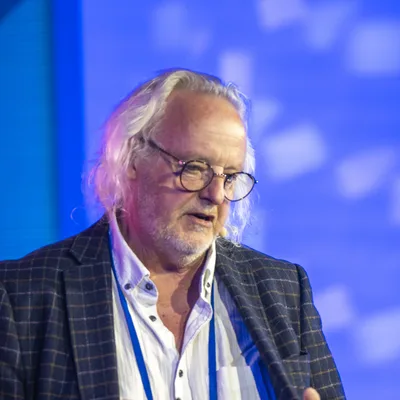

Owner and founder of RICHPiX
A visionary geospatial expert with 40+ years in revolutionizing info management, spatial data capture, and applications. Inventor of the 32-bit photogrammetry method, I leverage tech like Immersive GIS and AI to advance reality capture for broader use.


