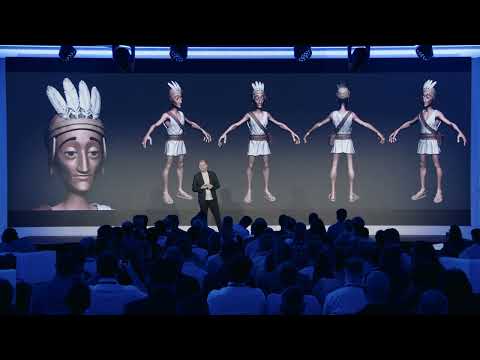

Adam Havkin of Scan The City shows how scans of the old city of Jaffa, first captured with a Sony camera and later with the XGRIDS PortalCam, became an online multiplayer game in Arrival Space. Adam explains how dozens of separate splat scans are linked with portal-like gates instead of one merged model, how vibe coding turned static gates into puzzles and mini-games, and what stress-testing the PortalCam taught about scanning technique.
“You have an avatar, and you walk with it like a game.”
“And the thing is that anything you do in one space can be copy, modify to another space or another project.”
“I can tell you that, um, the weirder you go with it, the better, uh, result you get.”
Adam linked separate scans with gates in Arrival Space, each with an exit point, an entrance point and a spawn location, instead of merging everything into one giant model.
According to Adam, the same scanner, parameters and computer gave a significant improvement just by walking and holding it differently, and unusual movement helps the algorithm.
Yes. Adam keeps adding scans, including another museum once its renovation ends, so the game is live and looks a bit different on every visit.
Transcribed automatically (ElevenLabs Scribe) and lightly edited. It may contain small errors. Click a time to play the video from there.
Adam Havkin: Thank you. Hey. Hi. Uh, my name is Adam from, uh, Scan The City, Tel Aviv. And before we start, quick question.
Adam Havkin: Um, who can read this? Just raise your hand if you can. Um, this is written in Aravrit. Uh, it's a font that blends Arabic and Hebrew together in a way that everyone can read it in their own language, um, but without cancel the other. And this word means Jaffa.
Adam Havkin: And today, I will speak about, uh, blending, uh, Gaussian splats from the old city of Jaffa and vibe coding to create a game. And this project actually started here in the last, uh, 3DISE event, uh, where I also got to speak. And I really like this conference. It's small in a good way, community. Um, you can meet all your friends and approach anyone.
Adam Havkin: But, you know, the most, uh, interesting conversations, they don't happen here on stage, um, but bet-between sessions in the more, uh, informal meetings. And one of these conversations was with Christoph Schindler. We were in the smoking area having beers and wine, and he showed me this platform he's been using called Arrival Space. And, you know, back then, a year ago, there weren't that much options to view or share, uh, splats online. And what I really liked about this platform is that you don't move or orbit a 3D model.
Adam Havkin: You have an avatar, and you walk with it like a game. And unlike other viewers who added support for splats, Arrival was built for them. I was mainly using, uh, my Sony camera to capture and LichtFeld Studio to process. It's an open source tool. Um, this is the older interface.
Adam Havkin: Now it's much, uh, easier to install. You don't need any computer science background or go deep down to the GitHub, uh, maze. And it's very, very good for both high reach detailed, uh, environments like this garage, um, where it reconstruct all the smallest, uh, details, but also for, um, more basic scenes, um, like this room, uh, where you have smooth, uh, featureless surfaces. Um, yeah. And I also got the mirror in the back.
Adam Havkin: So with Gaussian splats, you can, uh, capture very difficult, uh, environments and render them in a very realistic way, like museums with all the white walls and ceilings, um, the glasses and all the items and lights. And you can really get almost as good as your input image. Also, in terms of file size and optimizations, these, uh, three rooms I managed to squeeze down to a twelve megabyte, uh, file size. And for another ten megabyte, I could add a few more items that could... that I scanned separately and have a really optimized, smooth, um, online experience.
Adam Havkin: I was also into, uh, optimizing the capturing and build these different setups for different, uh, situations in the field. But, uh, with one Sony or even two, it wasn't, uh, efficient enough. So I needed a few more cameras or, uh, something else. And then I saw this post by Christoph, um, where he showed this amazing scan of a skate park using his new, uh, PortalCam, and I immediately knew I wanted, uh, two things. I have to get this Portal thing and to find a skate park.
Adam Havkin: So I reached out to Mindy, uh, from XGRIDS, uh, quite a lot according to LinkedIn, and I may have developed a slight FOMO, uh, for this device. But eventually, the DHL guy came, and I got my XGRIDS. The first, uh, scan I did was later that day, very late at, uh, two AM in the morning after a night out at a local club. And then I took it anywhere, um, to try it, to test it, to learn it until I felt ready. And I went to the...
Adam Havkin: I waited for a cloudy day and went to the skate park. Um... So for me, uh, the PortalCam really was a great add-on to my toolkit. I mean, it's small size. I can take it anywhere.
Adam Havkin: Um, and you walk with it. So you can now capture in minutes- Um, things that would take hours or even days. Um, and the quality was really good for both, um, indoor scenes, but also for outdoor. Um, this is-- all these video clips are from the first, I think, week or two, uh, with the PortalCam and CapCut. Um, yeah.
Adam Havkin: And one day... Oh, sorry. One day, I got a call from a very good friend, uh, his name is Barack, and he told me he's filming in this old, um, building in Jaffa, and I should come. Fifteen, twenty minutes later, I was there, uh, with the PortalCam, and it was a very old, abandoned, locked space. Everything that I like.
Adam Havkin: So we scanned it. And there I also met with Avi, who basically has the keys to Jaffa, and he took us to another space in this, uh, building, which is a locked archeological, uh, museum. So we scanned it as well. And a few days later, um, I came back. I thought it would be nice to add an external scan to connect the two, uh, spaces together.
Adam Havkin: I also got these stickers that I can place and use as a map fuse point, uh, for the scanning. And I did the external scan, and then it happened, and I started over-scanning everything, and I added a few more. So each polygon you see is a different scan, and this was really my place to stress test, uh, the PortalCam, um, to see how big or small the polygon should be, uh, to avoid alignment issues, how fast or slow or weird I should work with it, um, to get better results. And one way, um, to view this progress is by comparing identical items that you see in, in, uh, different captures, like these defibrillators, um, that are scattered across the city. Most of the scans were done at cloudy days, so I get nice, flat, even, uh, colors across the scans, even if done at, uh, different days or hours.
Adam Havkin: The entire area, it sits on a hill with a lot of alleys, uh, so it's all, like, 3D. And I even got between the buildings in all the smallest, uh, tiniest, uh, narrow spaces. And in the end, I decided not to merge everything into one, uh, giant model, and instead I used these, um, gates, like portals that you can place and connect different spaces together. Um, you can set a exit point and a entrance point and spawn the player anywhere you want. Um, this gate is Jaffa five-eight, which means it goes from Jaffa five to Jaffa eight, and this way I could keep track on all the different, uh, gates across the game.
Adam Havkin: And then something happened that really changed everything, and that is when Arrival added vibe coding to their platform. Which means that now instead of a static, passive gate, you can have a interactive one, where you need to have a gold coin, uh, to open the door for the gallery, or to win a tic-tac-toe game to enter the museum. Um, so here I used the scan architecture with this three-by-three grid, uh, as a board for the game. Um, the problem with this game is that it will always end in a draw if, uh, you don't make any mistakes. So, so I had to adjust the AI to be j-just less, uh, smart, to not always pick the best move.
Adam Havkin: And there are plenty of items that, uh, you need to find, and you can even pick them up, like this old key that you need to go into another space. Some items are hidden, embedded inside the scans, like the defibrillators, which will give you a heart. Or using Three.js magic of, uh, view dependency, uh, you need to find the invisible cat, which you can only see from a single direction where it was scanned. This is the first, um, space, and whenever I w-- I go there, past there, I see people trying to look in, and now they can walk in and explore everything in, uh, 3D.
Adam Havkin: Um, this place is also full with bats, so I added them in the game. There is a tour guide that can take you to, uh, different locations, and it is a, it has a whole, uh, navigation system similar to drone with waypoints that you can, uh, manipulate. And the thing is that anything you do in one space can be copy, modify to another space or another project. So this is really, um, like a big sandbox for me, experimental, to use different, uh, things, um, from scanning and processing To creating custom, uh, features using, uh, AI, uh, vibe coding or other tools, um, like o- other AI tools to create sound effects, 3D assets, or images. Um, ah, it's so small, the pointer.
Adam Havkin: Anyway, the minimap, for example, is a historical... historic minimap with all the icons, was created using, uh, Luma AI from a satellite, uh, reference image. So I could actually match it more or less to the scan, and you can navigate with it. Um, but this is not only a technological, uh, experiment, this is al- also a social one, um, because this is an online multiplayer. Uh, so let's play.
Adam Havkin: So this is the, like, opening, uh, level that you see. Um, you have all these items that you can pick. I know where they are, so I will go there. So you see I got a fish and a orange. And wait, there are people already here.
Adam Havkin: So, all right. Who is this? Okay, this is Michael, obviously.
Host: 2D is against my religion. 2D is against my religion.
Adam Havkin: No sound?
Host: Juding, juding is against my religion.
Adam Havkin: It's very, uh, low, the sound maybe. Okay, people are joining in. Let's hold another one. Try another one.
Host: 2D is against my religion.
Adam Havkin: Okay, now it works. And you can create anything you want, uh, with this vibe coding. Any feature that you think you, you want, you can do. See, people are already joining, but we'll do one more.
Host: So what I want you to do right now is scan the QR code behind me.
Adam Havkin: And if you scan this QR code, we should see you entering the game. And let's see another interactive. To enter, you need the gold coin. So you need to play a really quick, uh, heads or trail. You can pick what you want.
Adam Havkin: And you can play it for a while. Maybe I need to adjust it to be a bit, uh, easier. Okay, I got the gold coin. And you can do whatever you want with it. It's, uh...
Adam Havkin: Okay, it's getting crazy. And, um, the idea is that you can walk in Jaffa, uh, for about two hours, not to repeat your, uh ... Yeah. It has a delay. Um, ugh, this is becoming...
Adam Havkin: Walk. Anyway, you can travel, uh, explore Jaffa and walk around for, like, two hours, not repeating the same area, enter in and out of buildings. And there are a lot of interests, uh, in terms of tourism- ... in terms of, uh, local businesses that, you know, if they see maybe there are a lot of players, a lot of views, they would want to add their, uh, business to the scan. Um, that's it.
Host: Thank you so much, Adam. Thank you. So let's take a look at the questions from the audience. And I recognize that voice.
Adam Havkin: Yeah. I just, uh, told the AI I'm preparing for the 3DISE, uh, event, and he made it.
Host: Awesome. Good stuff. Mm, so let's take a look at the questions. So the first one, uh, Adam, you showed us a comparison of two defrib- defibrillators. Uh, what exactly, uh, should we see in that kind of a comparison?
Adam Havkin: Um, okay, let's look at this. So, so what you see it is, uh, ah, you don't see.
Host: Uh, can, can we get, uh, the presentation back up? Yeah.
Adam Havkin: Okay. So what you see is, is just the same, uh, item in different areas, in different, uh, scan. One was, uh, Jaffa 3 and one is Jaffa 6. So it's just how I walk different. The same scanner, same parameters, same, uh, computer, but only different, uh, walking.
Adam Havkin: And you can still get a significant, uh, improvement just by, uh, walking and, and holding it, uh, differently. Um, I can tell you that, um, the weirder you go with it, the better, uh, result you get. Like, you need to really, uh, do, like, weird stuff with it, and it really helps the algorithm.
Host: Mm-hmm. Thank you. Let's go back to the questions, please. So, um, Adam, you showed us that you scanned, uh, certain locations, uh, of the city. So do you plan to do similar projects in the future or potentially adding new location to the existing project?
Adam Havkin: Yeah, yeah. There's, uh, the, the, this-- I always add... I mean, I, on Saturday, I added a scan. It's still not there. So I keep adding them.
Adam Havkin: I'm waiting also for some renovation to end in the, another museum so I can add it. Um, so yeah, it's, it, this is the idea. It's a live, uh-
Host: Mm-hmm
Adam Havkin: game, so every time you will enter it, it will probably, um, look a bit different, and we'll have more spaces and things to do.
Host: Mm-hmm. Got it. The last question: Are there any plans to add AI to the game that would interact with the scanning system and dynamically change the weather, seasons, and similar conditions?
Adam Havkin: Um, so I guess you could, um, at some point connect it to some live feedback from the city to, uh, maybe time of the day, to a season, to other inputs. Uh, I don't see any problem with this. Yes.
Host: Okay. Perfect. Ladies and gentlemen, Adam Havkin.
Adam Havkin: Thank you.
Host: Thanks. Thank you.

SCAN THE CITY
Is focused on the digital preservation of urban environments. Through his project Scan The City, he explores the intersection of architecture, technology, and cultural memory. Adam is highly engaged in the research and practical application of Gaussian Splatting, particularly its integration into…