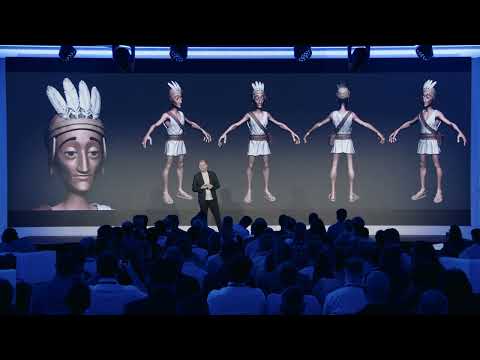

Luk van Goor shows how combining photogrammetry with photometric stereo, focus stacking, UV, infrared and CT scanning pulls far more out of heritage objects than a single technique can. Through case studies from a nineteenth-century trophy to a Bronze Age urn, Luk explains how each added layer reveals something new and why understanding your tools matters more than just using them.
“every time we add a layer to the object, it tells us something new, because there's always more to see than our eyes can pick up”
“Archeologists, conservators, a medical CT team, each bringing something the others can't.”
“So my message is really simple: don't just use the tools, understand them.”
Luk van Goor said no other technique Luk knows gives as much information about the surface, and photometric stereo is flexible enough to get close to the object and use different lenses.
Luk scans with Sony cameras and removed the camera's IR-UV blocking filter to capture beyond the visible spectrum.
According to Luk, cremation remains are charred and black, so they absorb the light and appear as black dots in the infrared scan.
Transcribed automatically (ElevenLabs Scribe) and lightly edited. It may contain small errors. Click a time to play the video from there.
Luk van Goor: Hello. Okay. Well, let's first watch a movie. Okay. Oh, thank you.
Luk van Goor: So, um, for a few weeks ago, I went to my parents' place and, uh, I came across this. So that's my diary. And on the top it says, "My future." So apparently eight-year-old me had a very clear future, because what I wrote was, "If I grow up, I wanna become an inventor, and I love to dream about becoming an inventor one day." Okay.
Luk van Goor: So but honestly, it was just curiosity. I wanted to know how everything worked. So as a kid, my favorite book actually was How Does It Work? And I think if I'm really honest, I'm still that kid. I still want to know how everything works.
Luk van Goor: Because once you understand how something works, you can start to tweak it, you can push it, you can combine it with something else and see what happens. And that's what this talk is all about, to see what happen-- can happen if you really understand the technique you're using, um, so you can push it behind, uh, the obvious. So through a few practical examples of some recent work, we're going to answer the two following questions. How do we pull more detail out of a 3D scan than we thought possible? And the second one, how do we see things our eyes cannot?
Luk van Goor: Okay. But before we start, a little bit about myself. So a big part of what I do is making replicas, replicas for museums, exhibitions, researchers. And making replicas is really cool. It's really cool.
Luk van Goor: Um, but we always want to improve our 3D scans, and that's what we do. That's what we're here for, some of us. Which brings us-- what brings me to the first question: How do we pull more detail out of a 3D scan than we thought possible? While researching how to improve my 3D scan, I came across this technique, uh, called photometric stereo. And let me first show you what-- how this technique works.
Luk van Goor: So you point a camera at an object and take photos with, um, light coming from different angles. The computer then calculates the depth from the shadow, capturing all the tiny details. And from that we can generate, for example, a normal map. You can see every minuscule detail, down to the fraction of a millimeter. And that got me thinking, what if, what if we combine photogrammetry with photometric stereo?
Luk van Goor: And it actually worked. And on the left side you see classic photogrammetry, on the right side the combined technique with photometric stereo. And I'd love to share a few examples, uh, what a combined scan can, uh, like this can deliver, and, uh, we're gonna look at three case studies. So let me see. Oh, that's the wrong button.
Luk van Goor: So we're gonna look at, um, this trophy engraved with engraved names barely visible, and then we're gonna look at a tobacco tin that comes to life. And what if we add focus stacking into the mix, and AI? So let's take a look at this beautiful trophy. So this trophy is from, uh, 1882, from Düsseldorf, and a lot of painters scratched their signature into this trophy and on the surface, and it was very hard to read. So think of it as a, a guest book, but then just-- but then made of metal.
Luk van Goor: Um, so we combined photogrammetry with photometric stereo, and then all the names came back and were very easily to read. Um, now we are going to see a normal map, but actually the height map was even better to see, to read. So, and we found out that, um, these were very important painters whose work hangs in museums today. And a beautiful result. Little bit too fast maybe.
Luk van Goor: Okay, then let's look at the next one, the tobacco tin.
Video: Behold this exquisite tobacco box, a true treasure of the past, now brought into the light by modern technology. This beautiful tobacco box was scanned using a combination of two techniques, photogrammetry and photometric stereo technique. Additionally, the reflections have been mapped. What makes this box even more captivating are the two historical inscriptions it bears. On the lid, alongside an evocative iconographic representation, is the inscription, "Whoever rests on work half-finished soon loses his wit and judgment."
Video: On the reverse side of the box, another timeless maxim is inscribed, "No swifter is the time that slips away." These venerable words speak to the fleeting nature of time and the value of diligence. What a magnificent find. A perfect marriage of historical depth and contemporary technology.
Luk van Goor: So, and, um, I hope the next example doesn't go so li-- against Michal's religion, because it's a little 2D. But, um, we're going to look at a Roman curse tablet recently found in Heerlen, in, uh, the Netherlands. And, um, they were used to curse someone or some group. And when we combine photometric stereo and focus stacking, we got some really sharp results. And in this way, AI can also see every small detail.
Luk van Goor: And because of the combination of these three techniques, we can, uh, read something that is almost two thousand years old easily. And this is just the beginning of the AI era. So, a metal cup showing us names, a tobacco tin coming to life, and a curse tablet finally read after more than th- two thousand years, almost two thousand years. And that's-- that answers the first question. So how do we pull more detail out of 2D scan than we thought possible?
Luk van Goor: Well, combining different techniques. And what about the second question? Whoops. Um, how do we see things our eyes cannot? When I was a kid, I used to take everything apart.
Luk van Goor: Like, anything you gave me, like, uh, electronics, pens, wasn't safe for long. I wanted to know how it worked, and that also didn't really change. And I hope nobody from Sony is in the room right now because, uh, every camera uses an IR-UV blocker. So I had to take this filter out to see behind the visual spectrum. We're going to look at three case studies again.
Luk van Goor: I'm going to show you what UV revealed about a Roman pot, and what happens when you add a CT scan to the coin hoard, and finally, a more recent test. So this Roman pot, uh, needed to be scanned, uh, to see how it, how it has been restored a hundred years ago, before re-restoration. And what you're going to see is normally not visible for the eye. So the blue pieces are fillings, and the yellow lines are the glue, and this helped us with the re-restoration. So this is done with UV 3D scanning.
Luk van Goor: Let's look at this coin hoard, Roman coin hoard, also find- found in the Netherlands. We're looking at, um, so a coin hoard. And, um, when we combine this with a CT scan, we could actually see what is happening inside this, um, block lifting. So here we see a conservator at work with this block lift, and he knows exactly what to expect thanks to the combined scanning technique. And it's practical, that advanced knowledge makes removing the soil so much easier.
Luk van Goor: And then the last one, a Bronze Age urn, around three and a half thousand years old. This is a more recent case study. The others were from two thousand twenty-two. So, um, you see an urn in a field, captured in its original position. And back at our studio, we made a 3D scan with a SpectroFusion scanner.
Luk van Goor: And you can also see, uh, the bronze ax sticking out, and the bracelet. So in the next picture... Let's go. Okay. So the next picture is showing us photometric information and normal map mixed with a height map.
Luk van Goor: Again, you can see every crack in this, uh, surface very clearly. And then under UV, under UV something, uh, interesting happens. You can see some lines in there and some crosses, also invisible to the eye. And then also in UV, the bronze corrosion lights up. And then the infrared.
Luk van Goor: You can see the black dots, and those are cremation remains. And we can also add the CT scan, and that was very helpful with sectioning, uh, process, uh, later on. So... And none of the-- this is me alone. Archeologists, conservators, a medical CT team, each bringing something the others can't.
Luk van Goor: That's what SpectroFusion really looks like. Not a machine, a collaboration. We've combined photogrammetry with different techniques, and every time we add a layer to the object, it tells us something new, because there's always more to see than our eyes can pick up. And that answers the second question. Okay.
Luk van Goor: And all of this was possible because of curiosity and the question: how does it work? The question I asked myself as a kid. He wanted to be an inventor, and honestly, I'm not sure if he ever became one. I didn't invent one of these techniques, but I did take the time to really understand how they work. And that's the part I wanna leave you with, because once you understand how something works, you can start to tweak it, you can push it, you can combine it with something else and see what happens.
Luk van Goor: So my message is really simple: don't just use the tools, understand them. Take them apart in your head, figure out every step it's actually doing, and, um, yeah, stay curious. Thank you.
Host: Luk, thank you so much. Thank you so much-
Luk van Goor: Yeah
Host: for a really beautiful presentation. Let's, uh, bring those questions up on screen. Uh, once again, there are plenty. And, uh, let's start with the first one. What equipment do you use for scanning?
Luk van Goor: A Sony camera.
Host: Sony camera?
Luk van Goor: Yeah.
Host: Can you elaborate which model it is?
Luk van Goor: Yeah. A73 and A74R.
Host: Mm-hmm.
Luk van Goor: Yeah.
Host: Perfect. Thank you. So, uh, what's the ground sampling distance that you are achieving?
Luk van Goor: I have no idea, actually. No.
Host: Okay. Like it. Quick and short answers. Uh, why photometric stereo plus photogrammetry instead of different techniques like structured light or laser scan plus aligned HQ texture capture?
Luk van Goor: Okay. That's-
Host: Very specific one
Luk van Goor: that's, uh, more a question after this.
Host: Mm-hmm.
Luk van Goor: But, uh, yeah. Um, well, first of all, photometric stereo, I don't know any other technique that has-- that gives you so many information about the surface and also the flexibil- flexibility, flexible, you know, um, to get closer to the object and use different lenses. So that's why I'm using that technique. Yeah.
Host: Mm-hmm. Uh, Jeffrey's asking, "Do you work for a museum or are you independent?"
Luk van Goor: Independent. Yeah.
Host: Okay. Uh, and, uh, do you work with museums?
Luk van Goor: Yeah. Yeah. A lot of museums. Yeah.
Host: Mm-hmm. Mainly in the Netherlands or beyond?
Luk van Goor: Mostly in the Netherlands, but also Belgium and Germany. Yeah.
Host: Mm-hmm. Cool. Um, let's get personal. Uh, when did you first do 3D scanning?
Luk van Goor: Uh, five years ago.
Host: Five years ago. Real cool. Um, interesting one. Uh, that was-- What was your most favorite and bizarre item you scanned?
Luk van Goor: Oh, okay. Uh... Oh, well, that's a good one. Uh, I scanned a lot of very interesting, uh, objects, like, uh, oh, yeah, the last one was, um, D'Artagnan, the Four Musketeer.
Host: Mm-hmm.
Luk van Goor: Uh, we found it in the Netherlands. Maybe. After all, it was an illegal dig they told me. But, um, yeah, that was a very interesting one. But, you know, holding a, a three-and-a-half-year-old bronze sword and stuff like that, that's...
Luk van Goor: I mean, there are so many objects I've, I've been scanning, and it's beautiful. It's too much.
Host: Thank you. And let's wrap it up with the last question now, talking about the software that you're using. What is your preferred software pipeline for focus stacking, photogrammetric stereo, um, alignment, et-et-etc.?
Luk van Goor: I, I'll give you a list if you come to me after the, the show. But, um, uh, let-let's say, um, uh, I use RealityCapture, of course. Uh, a lot of programs. AI, actually, lately. Just AI.
Luk van Goor: Building my own workflows. Yeah.
Host: There's one interesting one still. I would like to, uh, take that one. So you were talking about cremation remains, uh, over there. So how do you, how do you detect these cremation remains using IR?
Luk van Goor: They are-- The cremation remains are like, um, a coal stuff we call it in Dutch. Uh, but, um, it's getting black, so it absorbs all the light, and that's why you can see the black dots. Yeah.
Host: Thank you so much, Luk.
Luk van Goor: Yeah.
Host: Ladies and gentlemen, let's give it up for Luk van Goor.

Researcher/Developer, Specialist digital Heritage at Restauratieatelier Restaura
Learn what you enjoy and what you need, and you’ll still have room left for your own ideas.