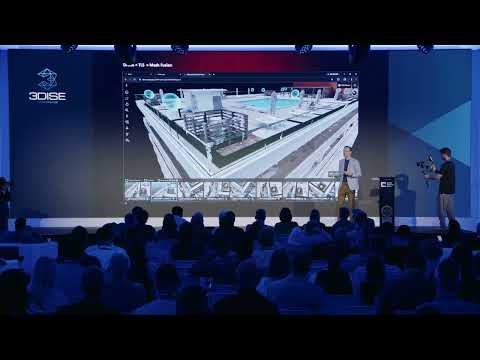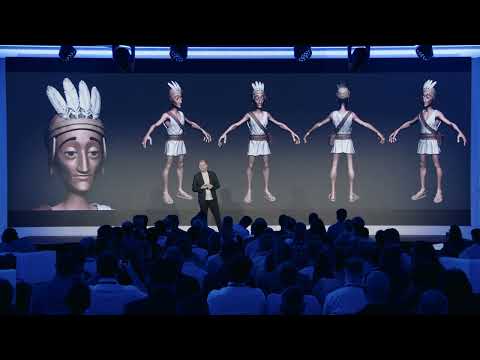

Christoph Schindelar traces a path from hybrid scanning, which combines photogrammetry, structured light, photometric stereo and polarization-based capture, to Gaussian splatting as a complete scan-to-delivery solution. Christoph shows recent projects in virtual production, damage documentation and cultural heritage, shares practical capture tips for better splats and looks ahead to AI editing and games built on scanned environments.
“I found out GS is not just another layer in my pipeline. It can stand for itself as a complete scan-to-delivery solution.”
“in the past year, I can tell you 80% of my projects have included Gaussian splatting”
“While photogrammetry forgives some misalignment, that's not the case for Gaussian splatting.”
Christoph Schindelar explained that Gaussian splatting is view synthesis and view dependent, so orthographic capture that works for photogrammetry misses viewing directions; scanning from many angles and with a wide field of view keeps splats from breaking.
According to Christoph, alignment is king: even the smallest misalignment leads to broken splats, so Christoph reiterates the alignment, for example by lowering the max feature reprojection error in RealityScan.
According to Christoph, capturing a church with camera rigs took hours while light conditions changed, whereas with the PortalCam the scan takes about an hour.
Transcribed automatically (ElevenLabs Scribe) and lightly edited. It may contain small errors. Click a time to play the video from there.
Christoph Schindelar: Thank you. Hi, guys. I'm super happy, uh, being able talking to you here. Um, to me personally, I'm an independent scan artist. Um, I mean, my work is maybe not as fancy as some of the stuff you see out there in the exhibition like Mosaic and so, but somehow my work made it to global recognition, and yeah, I'm super happy, uh, being able talking to you.
Christoph Schindelar: So, um, the title here is From Hybrid Scanning to Gaussian Splatting. Why? This is kind of reflecting my work over the past years. I started as a photogrammetry artist, headed over to improve this tech, and yeah, finally ended up now with Gaussian splatting. Um, speaking about hybrid scanning, um, I mean, we're all professionals here, so it's potentially not brand new for you.
Christoph Schindelar: But there is no one solution fits all approach. We all know that. And to get the point, here is a small example showing the same asset once scanned via photogrammetry purely, and another result from a structured light scanner. Both attempts has their pros and cons. Photogrammetry delivers super high quality textures, but it has a hard time with featureless objects and hard surface models.
Christoph Schindelar: So we can see this object would need a lot of love, um, from a sculpting artist, uh, to get it in a proper shape. On the other hand, structured light, since it's projecting a pattern on this object, it doesn't rely on trackable features. The mesh reconstruction is beautiful, but we have usually poor texture quality from the most structured light scanners that we have out there. Means combining these two tech leads to a superior result. What you see here on the right side was one of my first testings combining different tech.
Christoph Schindelar: In this specific case, it was, uh, photometric light sampling plus photogrammetry, and the result, I think, is super crisp and, and detailed. Following this attempt, I tried to push it to the limits, um, building my own hybrid scanner. It's pretty much what you see out there from Ryxus. So it's combining photogrammetry with structured light and photometric stereo plus polarization-based PBR scanning. Um, you can see in this example that we are really close to a super photorealistic, fancy one-to-one virtual copy of the scanned subject.
Christoph Schindelar: So on the left side is the reference photograph, and on the right side you see the rendering. Um, so I would say we, we are pretty close. Um, that also works for metallic subjects since we have a polarization-based workflow that captures cross polarized and parallel polarized. By that, we are able to extract also the specular color, which is important for gold and other metallic surfaces. If you're interested, there is much more on my ArtStation.
Christoph Schindelar: Um, yeah, there's a bunch of objects that I've been scanning over the time. Yeah. With the goal to produce best possible quality, R&D is an important part of our work. And yes, it is. It's like fifty percent of my work is researching, testing, looking what's new on the market, and how we could potentially implement new tech into our pipeline.
Christoph Schindelar: And when NeRF came up, my initial idea was, "Is it possible to extract additional PBR data based on that approach?" Um, since it's a volumetric capture, we have transparency, semi-transparency and, and all that stuff captured With the approach, and the idea was to use that data to, to improve my, um, my pipeline, but it turned out it's much more than just that. So what you see here, the video was one of my very first, uh, demos that I showed on YouTube. My first tests if, if you want, with Gaussian splatting, and it was incredible already. Um, I found out GS is not just another layer in my pipeline.
Christoph Schindelar: It can stand for itself as a complete scan-to-delivery solution. Um, the core benefit is the economy. I mean, where in a traditional pipeline, usually you have to remesh, retopo, UV, unwrap, texture, reproject, and, and there are many, many steps in the pipeline that are needed to produce a, a proper result, and you can skip most of that, uh, if not all of that, uh, by using Gaussian splat-splatting. What you see here, this winter forest is, by the way, um, a real-time online render using Arrival Space. Um, so that's actually scanned with a PortalCam, uploaded, and now you can walk around in this forest.
Christoph Schindelar: So from my perspective as a professional scanning artist, there is a shift happening. Um, in the past year, I can tell you 80% of my projects have included Gaussian splatting, and that started with, uh, film projects and virtual production. So what you see here, uh, I mean, unfortunately, I cannot show you final footage, but this is a presentation of our first test that we did in, uh, the virtual production studio. Um, you see on the left, this is, uh, a tiny VP studio in Vienna, and we even didn't use proper lighting or something. So this is just a quick test shot that already showed how capable this approach can be.
Christoph Schindelar: In the meanwhile, I see more and more studios, uh, coming up with the idea of scanning their film sets. I mean, building up a film set is expensive, and after you shoot, you throw everything away. Um, and by using an affordable scanning method to preserve all your film set makes a lot of sense. Another topic in the last year was, um, visual inspection and damage documentation. So what you see here is, uh, a transformer station that burned down in, in Austria, and we've been hired to document the damage for visual inspection.
Christoph Schindelar: So of course, they have to repair this transformer as fast as possible and make it working again. So by documenting the damage, you can later on visually inspect what happened, and this data is used for the insurance case and so on. Um, this is another hybrid approach, if you want. So we used airborne and ground-based lidar scanning for measurement and accuracy, and for the visual inspection, uh, Gaussian splatting, of course. Also, a very nice project was this interactive installation on the exhibition Gateway to Democracy, where we scanned the Coat of Arms Hall in Carinthia.
Christoph Schindelar: This scan data was then used in a Unity project to provide an interactive experience at the exhibition. So actually, you can visit the place and explore all these different coats of arms in an interactive, uh, way. And yeah, it's pretty cool and, and unique. There are not much projects in this direction. Um, and I also have been allowed to show the scan online, and many people were pretty much stoked about the quality of, of the data.
Christoph Schindelar: And yeah, this is one of my most beloved projects over the past year. So we've been able to scan, uh, the Kefermarkt Church in Austria. Um, this was a very early Gaussian splatting approach, so there was no XGRIDS scanner or anything. This was basically scanned with a single DSLR camera. Scanning time was about four hours, if I'm not wrong, and quality is crazy.
Christoph Schindelar: Um, it is still the most liked scan on SuperSplat, and many people are using it as a reference to show, um, to show quality of Gaussian splatting approaches. I have to thank, um, the team around, uh, JC, Grieco and Florian Butcher. Uh, the fun story is we met here last year at the same, uh, congress, and I showed them what, what I achieved in, in Arrival Space. And so they decided, "Okay, let's, let's give it a test. Let's make this POC and, and look what happens."
Christoph Schindelar: After that POC was a huge success, we ended up with the full-scale heritage project, which was, uh, scanning the Gothic, uh, Straße in Deutsch, uh, the Goth- Gothic route, uh, that included thirty-two sacred buildings, interior and exterior, a large variety of artifacts in addition to the buildings, and also the Kefermarkt altar, um, that was finally scanned with over fourteen thousand images. Um, we had a crazy amount of data collected, and of course, you can render it locally, but turned out when we convert it to a synthetic splat, we can show it online. Uh, so that's what we did. The, the project is not released yet, but I think it's about to be finished. Uh, JC is the head of the project.
Christoph Schindelar: Feel free to talk to him, and I'm exciting looking forward to the release of, of the whole thing. Speaking about hybrid scanning and XGRIDS PortalCam, which is super famous. Meanwhile, many people using it, and we also did for scaling the project. What started with a single DSLR camera ended up with, uh, the PortalCam because of its efficiency. When we scanned with Sony cameras later, dual camera rig, action cams, three hundred and sixty degree cameras, whatever, it, it took hours to capture the church, and you have the problem that light conditions are changing and so on.
Christoph Schindelar: Uh, that was a challenge. With the PortalCam, the scan actually takes about an hour, and so it's super efficient to, to work with this machi-machine. Thanks so much to XGRIDS for supporting our project here. Um, finally, your giveaway from this session, um, how to make good scans. I mean, I'm also working as a consultant.
Christoph Schindelar: Many people are reaching out, asking me, "How can you achieve that quality? What's the trick?" Um, so I'd like to, to give you some minor tips. First, Gaussian splatting is a view synthesis. It's view dependent.
Christoph Schindelar: An AI algorithm will look at the reference image and try to arrange the splats so that it matches this reference. If you just capture orthographically, that works fine for photogrammetry, but, uh, not for Gaussian splatting because you are missing the different web-- vectors. So if my render camera is angled instead of parallel as we have it in, in an orthographic workflow, uh, the splats will break. So scanning from different angles Going around, scanning upside down, downside up, left, right, whatever, makes a huge difference, uh, in this approach, and this is also true for a PortalCam scan, by the way. Also, the field of view is, uh, important.
Christoph Schindelar: I found out when I'm capturing, for example, with a forty millimeter lens, and then I render with a twenty-four millimeter lens on the edges of the rendered image, also the splats will start to break. So I recommend using a very large field of view. And secondly, alignment is king. While photogrammetry forgives some misalignment, that's not the case for Gaussian splatting. Even the smallest misalignment can lead to broken results.
Christoph Schindelar: Um, so my tip h-here is, if you are not working with PortalCam, if you work with a DSLR camera or thr-three sixty degree camera or, or whatever, focus on the alignment. Try to reiterate the alignment and make it as good as possible. Here is a tip if you're using RealityScan. I'm using it, as you can see on my T-shirt. Um, we have this max feature reprojection error.
Christoph Schindelar: That's kind of a threshold, um, that tells how much tolerance the alignment can have. By reiterating the alignment and reducing this threshold, you can get superior alignment results, and that is really a key for Gaussian splatting. So the better the image quality, the better the alignment, the better your result will be. Looking into the future, what's next? Uh, so obviously we see a lot going on in the AI market, and AI plus scanning is supposedly the next step.
Christoph Schindelar: Um, if you have worked with Visu's NanoBanana, whatever, it's actually easy to have an image and then prompt an iteration, a image generation on top of it. The next step will be that you can do that spatially. So you have a spatial environment. You potentially will be able to upload your Gaussian splatting scan as a PLY and then prompt some modifications to it. So logically, this will be one of the next steps that, that we see in the market.
Christoph Schindelar: And the second thing I'm also involved in is Gaussian splatting entering the gaming market. So that was one of our latest projects, Forgotten Dream. Um, that's all-- or these two are, are on Arrival Space. Uh, Thomas, the CTO at Arrival Space, helped me working on that scene where you have relighting options in real time on your Gaussian splatting environment. This one here in the middle is a proper skate game.
Christoph Schindelar: You should really try it out. It's so much fun. We even had some small events there. Uh, I mean, Adam Hafkin showed you, uh, I think so that you can log in at the same time, so it's a multi, uh, player game. Um, yeah.
Christoph Schindelar: And then you are collecting letters and try to, to, to make a best time. Uh, y-you can even make a kickflip trick, so it's, it's really cool. And the one here on the right side is pretty new and already made some waves in the gaming industry. Um, Yakov Samigin, um, worked on that FPS shooter based on a scanned environment. Uh, by the way, that's also a PortalCam scan, um, a lost place in Austria, and it's super amazing.
Christoph Schindelar: We even made it to PC Gamers, Hacker News, and Tom's Hardware. So let's connect. Thank you for your attention.
Host: Chris, thank you so much. Thank you.
Christoph Schindelar: Sure.
Host: Thank you. Good stuff. We went a little bit over time, so if they wanna ask you any questions, they can still do that. Uh, just, uh, you know, to be respectful towards the others, let's take the Q&A basically sort of off the stage if, if that's okay.
Christoph Schindelar: Of course.
Host: Chris-
Christoph Schindelar: You're welcome.
Host: Thank you so much.
Christoph Schindelar: Thank you.
Host: Let's give him a ri- one round of applause.

Independent Scan Artist, Pipeline Developer, Consultant
An award-winning scan artist focused on high-end reality capture, scan-based innovation, and Gaussian Splatting. He founded RD-Textures in 2015, a globally recognized project that later became part of Epic Games. His work bridges production, pipeline development, and technical innovation across a…