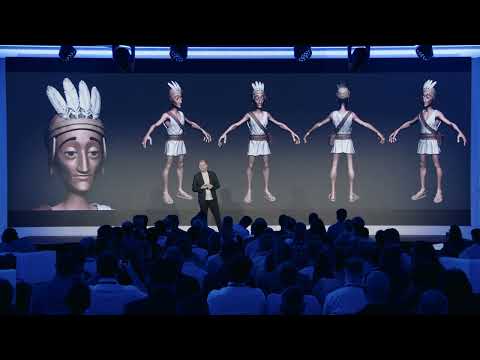

Tomas Barnas, founder and CEO of Overhead4D and co-founder of 3DISE, shares capture rules for large-scale photogrammetry and shows how Overhead4D combines photogrammetry, laser scanning and Gaussian splatting in Unreal Engine to give cultural heritage data a second life. The projects range from castles and historical reconstructions with historians to 6,000-year-old fossil trees for Expo Osaka and a shipwreck reconstructed from dives, presented through AR, VR, projection on 3D prints and an AR spyglass.
“If you take a JPEG, the data are dead. You can't do anything with them.”
“Eighty percent overlap, thirty-degree angle of the cameras, and capture in RAW. It's more data, but really do it. That's worth it.”
“the beauty is to get them or give them a second life.”
Tomas Barnas recommends about eighty percent overlap and around thirty degrees between neighbouring camera angles, and capturing in RAW so the images can be delighted.
According to Tomas Barnas, Gaussian splats are easy to produce, so they work well as an addition to a project and an upsell with low effort rather than the only deliverable.
Tomas Barnas shows scans combined with historians' research to visualize how places looked in the past and delivered through AR, VR, interactive applications and projection onto 3D prints, giving the data a second life.
Transcribed automatically (ElevenLabs Scribe) and lightly edited. It may contain small errors. Click a time to play the video from there.
Host: We'll be talking about castles and capturing them in 3D. So please take out your phones, and I would like to ask the AV team to put the Slido up on the screen. And I have a fun question for you because we are going to hear very shortly the presentation from Tomas Barnas, the co-founder of 3DISE. And they've been scanning the castles in Central Europe. So how many scans do you think they have already created?
Host: Let's take a look. What are your thoughts? Eighteen, fifteen, ten, twelve.
Tomas Barnas: All. All of one.
Host: Sorry?
Tomas Barnas: It should be all of one.
Host: Yeah. Should be. Actually, just a fun fact, there are one hundred and eighty castles in Slovakia, two hundred castles in Czech Republic, and five hundred castles actually in Poland. So a lot of work, uh, to do. And let's hear directly from Tomas.
Host: Tom-Tomas, come join me over here. What is the correct answer? How many castles have you, have you scanned so far?
Tomas Barnas: All of them. No, uh, not yet. Uh, the s- the right answer would be fifteen. Uh, but there are, like, multiple other buildings which are, like, similar to castles, so we don't count them in. But, uh, it's, yeah, a lot of historical buildings.
Host: Perfect. Thank you so much for joining me on stage. Tomas, take us on a journey on how to create a virtual experience from the scan data and the models. The stage is yours, Tomas.
Tomas Barnas: Thank you very much.
Host: Enjoy. Let's give it up for him, ladies and gentlemen.
Tomas Barnas: So I always like to start with little teasing video. Uh, this is everything what we generally do in overhead, or not everything, but this is, uh, what is the core, uh, use case and core target. So we are focused on cultural heritage. But besides that, we do digitization of, um, all kind of buildings or objects. And, uh, I would like to start, uh, with a slightly different topic, or, like, not exactly cultural heritage, but a little bit about knowledge sharing.
Tomas Barnas: And, um, I like to show it always about, uh, on the projects which are large scale, complicated to do, and where you need to think a little bit and plan how you wanna do it and how you want to achieve that result. If the scale is huge, if you're counting with thousands, thousands of images, and how to proceed, how to do it correctly. So this, what you can see here, is a project where we collected over a hundred thousand images, and it's the capital of Bratislava, and it's actually, like, a place where RealityCapture... It's processing RealityCapture, and this is their headquarters. And when you are doing capturing, sometimes you nice-- you can find Easter eggs, yeah?
Tomas Barnas: Like, for example, here, logo of RealityCapture and, and the, the co-founder of RealityCapture waving on you. Uh, this is cool if you have a big, uh, drone, so they can hear you from inside because they didn't know we are there, but nice waving situation. So the thing is, having huge data, what is the most important thing? How many people of you are using photogrammetry daily or, like, it's part of their businesses? Okay, many of you.
Tomas Barnas: So then many of you will know these numbers. So generally, we say, like, keep the overlap good, around eighty percent, and keep the angles of the cameras, like, following cameras, thirty degrees. It's clear. Everybody knows that. But what is the biggest mistake?
Tomas Barnas: Whoever starts with photogrammetry does something with the drone, something from the ground, and the first-- one of the first rules is broken. Thanks to the technologies and development, we have Skydio, we have, like, new DJI softwares which are, uh, supporting us with getting the right data, but this is really the core of the things. Like, it sounds super simple, but if you don't follow these two rules, it's very h- uh, hard to get, get the right data. Then we have also, like, other elements, and there was a great presentation yesterday from Barry about it, and that's about delighting. So I will not take too much time about, uh, to speak about this.
Tomas Barnas: But what you can see is, like, a photo from-- as a JPEG in the very direct light conditions. If you take a JPEG, the data are dead. You can't do anything with them. But the other picture is showing if you ta- capture RAW and then you extract the data out of them, what, what, what does it cost? So you can see here that's exactly...
Tomas Barnas: I will show you two types of data which are exactly the same, like, captured in the same time. So this is just captured in JPEG. You can see the geometry. When we capture the RAW and we just extracted light, so you do proper delighting, that's the geometry. Nothing more.
Tomas Barnas: Like, no more pictures, no more angles, no higher quality or higher resolution. It's just the same, and this is the comparison. So for me, like, two main messages, uh, or three. Eighty percent overlap, thirty-degree angle of the cameras, and capture in RAW. It's more data, but really do it.
Tomas Barnas: That's worth it. If you follow all of this, you are able then to grab and collect data which are big, which are large scale, which you can bring to Unreal Engine and bring their lightings and everything. So this is about what you saw. It's, like, about one year of work. But what happened last year, we got the Gaussian splat.
Tomas Barnas: So we are flying once around the buildings, and this is the result. So, um, thanks to technologies, we can say it's amazing how it's moving forward, and I wouldn't say that, like, support of AI would b- be taking our jobs. It's just helping us to create even better and, uh, larger experiences. And this is where it leads. Like, you literally have- Few of the-- few images, few flight throughs, bringing light in, and you can get impressive outputs like this.
Tomas Barnas: Bringing buildings in and, uh, that's everything very fast. Combining Gaussian splatting, uh, Unreal Engine, some new buildings. So that's a little educational part, but I would like to get back to that what I start with, and that's, uh, cultural heritage. Because we, in Overhead, we are a member of CIPA, ICOMOS, ICOM. That's organization, worldwide organization, which are taking care about cultural heritage digi-digitization, and that's where we try to be very supportive.
Tomas Barnas: So we go through all of these processes, capturing photos, uh, doing laser scanning, and combining them. Uh, what I love about this, uh, it's that during the process, you are getting also pieces of art out of that. Just beautiful point clouds. Uh, especially if you use NUBIGON. That's not a commercial, but like, that's like a beauty of point clouds you can get, get out of them.
Tomas Barnas: Uh, and, uh, here it's a combination again of everything. So very detailed photogrammetry, laser scanning, flying out from very super high details, nice lighting from Unreal Engine, and showcasing people, uh, what is there in these, in these heritage places. And most of the time, the purpose of this is to get the technical data for reconstructions, for anything. But it's... the beauty is to get them or give them a second life.
Tomas Barnas: So you, you can use them again, and you can create an applications which are very useful for, for people, for visitors. For example, in this castle, uh, they-- it's not, not open for public, so they just open a little location. You enter there, and thanks to, uh, products like this, you can bring people further. You can show them places which are unaccessible. And this all is just, I would call it, just from a reusing of the data which all of you are doing.
Tomas Barnas: So, um, there are multiple presentations also yesterday about it, like what to do with the data, where to store them, where to give them, to don't make a project and forget about the data somewhere on the flash drive. So this is how we see it, like bringing them back, back to people and use them and educate with them. Um, my favorite projects are not only about capturing and processing, but pushing this further and working, for example, with historians where you can gain, uh, drawings, researches, uh, of the past look of these, uh, beautiful places. And then combining all of these, you can create, uh, visualizations and bringing people back to the past. So it's about educating, and not educating just by saying words, but especially by showcasing and empowering the, the imagination.
Tomas Barnas: So here you can see nice like overlays and overlaps of the scanned current stage and the past stage, bringing in materials and, uh, all of nice structures that people and visitors can imagine how it really looked in the past. And, uh, those kind of data, uh, you can display in various ways. So this is still just an input, but what is outcome of that? Outcome can be anything. Anything you have in mind.
Tomas Barnas: Augmented reality, virtual reality, or any kind of like applications. But important is we are now able to bring this to, to people, to audience, and overlay it with the, with the realistic, uh, stuff on, on the places itself. Or bringing it into virtual reality, where again, great benefits are combinations of scans and Gaussian splats. So all what you see around is Gaussian splat. If we would like to capture this in photogrammetry, you would have to fly huge area and you will have like, uh, enormous data.
Tomas Barnas: Nowadays, you make the, the core thing which you, which you want to showcase. It's more detailed, and everything else is from Gaussian splatting combined into one experience. And visually, it looks always great because if you capture from the building out, then you are actually creating a nice background. For example, here you can still see that it's a little blurry, but even in reality or if you take a picture, you have a sharp front foreground and, uh, then more, more blurred background. Yesterday, there was a point that someone would like to see Petra.
Tomas Barnas: Many people were scanning Petra. We had luck just to be there for scouting and preparing some project which we will be able to show maybe end of this year. So not more about this, but, um, we have other showcases which we can use. And speaking about history and combining with also, uh, natural heritage. So not only cultural heritage, but nature.
Tomas Barnas: This what you see here are hundred and thirty-three fossil trees found here in Czech Republic. We have done this for a company, Czech company, Subfossil Oak, which is, uh, now a platinum partner of Expo, uh, in Osaka. And what you see are the trees which were transported there and which are part of the, uh, exposition in, in there. Uh, amazing on this project was that the, the trees are over six thousand years old. And then what you see here is photogrammetry with laser scanner, with laser scanning.
Tomas Barnas: Uh, they wanted to digitize them before they transport. The trees are easy to break, and they are very valuable. So we have all very high-quality details which can be used for these presentations or just preserving them in case something happens. So really enjoy this, this beautiful project. You can see all of these details which can be captured also in, in smaller scale compared to what I was showing.
Tomas Barnas: So the project is called Forest of Civilizations, in case you want to check it online. And we were also playing a little bit again with Unreal Engine, because what we like to do is not just to show how they-- the data look today, but how they can look in different scenarios. So for example, this was like simulating ice age and bringing a little bit of snow inside and giving other emotions into that. Speaking about snow, uh, the technologies can be used also in the mountains. Uh, even though the, the, the photogrammetry itself is not made for reflective surfaces, white surfaces, but still, even snowy mountains or mountains or rocks can be, can be done nicely.
Tomas Barnas: And, uh, again, like, a kind of a research project from our side I would like to share is once you have a nice scan, you can three-D print it. Everybody knows that. And, uh, we started to tackle with scanning, printing, and projections. So then what you see is real-time Unreal Engine projection of a day cycle on the three-D print directly. So, uh, slightly bad video.
Tomas Barnas: You can't see it very well, but you can see how the light is changing, and this is also a great approach. You can create, like, three-D prints in uni- uh, in one color and then map on them anything. So kind of a video mapping which you could see on the buildings, but here we have it on the three-D prints. Speaking about mountains, we can go also down below the water. Uh, and that was also one of, uh, very nice projects which we done with divers from Ocean Discovery in Sweden.
Tomas Barnas: Uh, the divers were discover... They discovered this wreck in year two thousand, and over ten years they were diving down to seventy meters, uh, below the sea level. They were capturing the boat to be able to reconstruct it. And what came out of the reconstruction? Three-D print in scale, painted, colored, and then again, reconstruction work together with historians.
Tomas Barnas: Gaining all the data, informations about this past look of the ship and, uh, combining it with the scan, which was also referenced in scale, allow us to create, uh, such a replica, which is, uh, very detailed. It took us around two years, this project. Not only working on it, but also, but, uh, during the discussions with historians and getting really the proper data. And once you have the data, you can just bring them to life. And one thing is making a video, the other thing is to make an interactive applications where you can play with it.
Tomas Barnas: You can still engage people and try to leave them or let them the possibility to choose what they want to see. So here you can choose the perspective. You can choose the view. You can see the movie. Everybody can see the movie from own perspective.
Tomas Barnas: So, like, the unique possibilities. Going further, as I said, like, the possibilities are endless. We came up with an idea that, uh, it's nice. You can see it on the screen, but how about being more engaged? Virtual reality is not always the, the, the best solution for museums or for, uh, places which are crowded.
Tomas Barnas: So we have came up with an idea building in an AR display into, uh, into a spyglass and giving a feeling that if you look at a spyglass, you are part of the, of the boat or on the-- of the battle, and you can look around yourself and see actually battle happening around you. So again, like, more engaging, bringing you into the, uh, the historical content and make you more, uh, immersed into, into that what is happening. But, uh, all of this is, yes, about the projects, but I was also mentioning yesterday that, uh, my target since we started with the company was sharing knowledge, educating people and, and creating more, uh, interest about the cultural heritage digitization. And that led to, uh, create, like, multiple workshops which we had, like, with, uh, with, uh, Scan 3D, with RealityCapture, FARO at that time, other companies. And, uh, we were visiting nice places, and it was something similar like, uh, Pete was showing with Alcatraz, but with, I would say, like, less, uh, less known places.
Tomas Barnas: So getting a group together, uh, making these fun projects where nobody really pays you, but you can collect the money at least to create this, uh, with a nice group of people. And what happens then? Then you invite these people coming here. Uh, who of you missed it yesterday, so I just wanted to, uh, to bring it up here. And, um, that's just amazing, like, uh, meeting all of you and then, then standing here and having everybody on, uh, uh, in the audience and, and watching this.
Tomas Barnas: So thank you for being here, for allowing us also to create this. I just switched it from, from overhead work to this. But thanks to all of you, and, uh, I hope you're enjoying it.
Host: Let's give it up for Tomas. Tomas, thank you so much for bringing us all over here, and another great example of a collaboration amongst the, the, amongst the community over here. A couple of questions, a quick one. Um, so you were talking about Gaussian splatting. So what is a good sales argument for a digital twin made with the Gaussians?
Tomas Barnas: Uh, it's, it's the easy way to produce it. So I wouldn't say that you, you need to sell it as the only thing. But as I was showing, uh, for us it's always great to have it and create something additional. Then normally you would have to ask double or triple higher price to get all of this into data looking good, and now with Gaussian splatting you can, uh, like up-- do, do an upsell with, uh, low effort.
Host: Mm-hmm. One more question. What is the name of the project, uh, Sail Experience? Do you mean the underwater? The underwater, um, boat?
Host: The shipwreck?
Tomas Barnas: Yeah. The ship, the ship is called, uh, Mars Makalös.
Host: Yeah.
Tomas Barnas: It's in Sweden. Yeah. And the museum is Västerviks Museum in, uh, in... It's like a city, uh, located, uh, hard to say. Like, on, on the coast, but, like, middle of Sweden.
Host: Mm-hmm. And actually you were talking also about another, uh, project, uh, with a-
Tomas Barnas: Yeah, that was, that was the same. Like, we did it together with a, with a company called Ocean Discovery.
Host: Yeah.
Tomas Barnas: There was divers.
Host: Mm-hmm.
Tomas Barnas: But the project was for the museum there.
Host: Cool.
Tomas Barnas: So that was, like, everything packed into one project.
Host: Perfect. Is it available online? Can people still check it?
Tomas Barnas: You can visit it there.
Host: Perfect. All right.
Tomas Barnas: I can give the address.
Host: Fantastic. Tomas, thank you so much. Let's give it up for him one more time-
Tomas Barnas: Thank you
Host: ladies and gentlemen.

Founder and CEO at Overhead4D and Co-Founder of 3DISE
An expert in reality capturing technologies and the Co-Founder of Overhead4D, a company that specializes in “TURNING THE REAL WORLD INTO DIGITAL EXPERIENCE” focused on blending innovative technologies with creativity. Im an expert member at CIPA Heritage Documentation and passionate about educating…