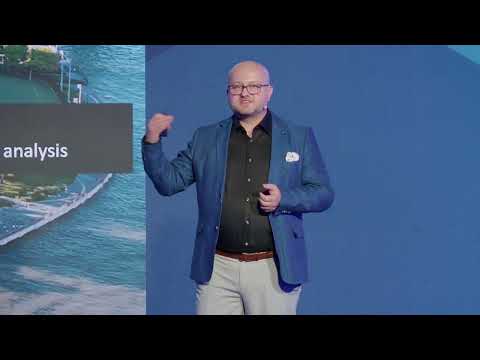

Josip Rukavina, CEO of Vectrino, explains how the company builds accurate underwater photogrammetry models of ports, breakwaters and quay walls, digitally "drains" the water and repeats the inspections over time. Josip covers the self-developed capture system that solved the banana effect, the time-shift approach that helps asset owners and insurers predict deterioration, and project examples from Croatia.
“we truly believe that understanding of the light and wavelength is more important than the type of the camera.”
“with the time shift inspections, you can teach computer how to say what is the time of the breakpoint.”
“you have to understand concrete is a live form. It lives. You, you pour it, and then it lives for hundred years.”
Yes. Josip Rukavina's team inspects breakwaters, quay walls and sheet pile walls down to about fifty metres, in clear to medium-turbidity water; in high turbidity multibeam sonar is the only option.
According to Josip Rukavina, sun near the surface creates zebra stripes that ruin the 3D model, which makes shallow areas in sunny ports the hardest part of an inspection.
Josip Rukavina said every project is different and needs preparation, and that artificial light is placed so the team never casts its own shadows into the images.
Transcribed automatically (ElevenLabs Scribe) and lightly edited. It may contain small errors. Click a time to play the video from there.
Josip Rukavina: Thank you very much. Hello, everybody. Uh, it is hard to outshine first Ted's presentation that he, he had with everything bridges, and then later we had a presentation. Uh, different presentations that are, like, stunning. There was a dog walking on, and I, now I had to outshine everything, but I will try.
Josip Rukavina: The name of the presentation is Drain the Ocean and Keep the Data, but the real name of the presentation would be Time Shift. This is something that Arash called me when we were talking three or four years, asked me, "Is the time shift the word you are trying to, uh, find?" Yes, the true, the time shift, and I will try to explain you how we drain the water and how we make time shift inspections. But first of all, I will just, uh, share a little bit about Vectrino. Vectrino is company that was founded twelve years ago by two brave people.
Josip Rukavina: Uh, my wife and I one day decided to leave corporate business, and then we started, uh, Vectrino. The, the first idea about Vectrino was to be special, but we didn't know what we are going to provide and what, what are going to be our services. But we found out soon that nobody's doing underwater inspection. Nobody. And we th-thought to ourself, "Okay, is there equipment to buy for underwater inspection?"
Josip Rukavina: And then we found out after one or two years trying to go around the world, trying to buy equipment, that all producers of underwater equipment are lying and not producing the equipment that we need. They were briefly showing us slow and, uh, small scale presentations of the three-D space, but it wasn't enough for us, especially as we wanted to make time shift inspection in the future. And then COVID strike, you know, and we had a lot of time, and then we decided it would be wise to develop our own equipment for the underwater inspections. We didn't thought that it is going to be so hard. Found out that, uh, it is going to be hard, but we also had lucky because sometimes stupid people are lucky.
Josip Rukavina: And we found solution, especially we found solution for banana effect. Whoever did photogrammetry ever in air know what is banana. It is curvature of the, of the everything. So you, you use GCPs to everyth-- to make everything flat. And you can imagine how complex it can be in underwater if you have two medias, air and water, and you don't have any GCPs.
Josip Rukavina: Okay. Uh, at this moment, we pro- we provide our clients unique technology for, uh, draining the water, especially in some areas. We are not the company that is doing oil and gas, deep water, and we are not the company that is doing the inspection that is deeper than fifty meters. And the reason why is because nobody's doing the inspection from zero to minus five-- f-fifty meters. And then we found out there is a necessity for such a job, and then we are going to, uh, make it.
Josip Rukavina: And how do we do it? We have few guys that are working seven days a week, twenty-four hours, three hundred and sixty-five degrees, going around the world with some fifteen or twenty-meter carbon pole and some cameras. And somebody, uh, few hours ago mentioned that, "Are you those guys with the GoPros?" Yes, we are those guys with the GoPros because we truly believe that understanding of the light and wavelength is more important than the type of the camera. Sh- We can do it with a full frame camera, with any kind of camera, but we would like to have it on a KISS principle.
Josip Rukavina: Keep it, you know, stupid simple, simple stupid, whatever. So we have guys that are just p- bracing down the road and, uh, by that way, they can do six hundred meters in one day, ten meters deep, so six thousand square meters, which is enough. Uh, especially if you're ever-- if you ever collect data, then six thousand meters per day per one technician is, uh, really, really a lot. So at this moment, we are doing the service around Mediterranean. We can work only in forty percent of the world seas because we work only in clear water to medium turbidity.
Josip Rukavina: If the turbidity is high, we are not the answer for that, for that pers- Surely not the answer. But if the medium turbidity and clear water and which is maybe whole Mediterranean and Caribbean and all beautiful places, we are down there and working. And we have three teams that are constantly working. Bringi-bringing the data to the company, so we can better understand the procedure. If we, we can better understand procedure, then we can be quicker.
Josip Rukavina: If we are quicker, then we can, uh, make it, uh, we can sell it better. Okay. The, the thing that I mentioned already, we can do six thousand square meters per day, and this is important. The guy who is collecting the data doesn't need to know anything. He just needs to po- place the rod down to fifty meters and then bring it up.
Josip Rukavina: Everything else is, uh, done by electronics or our, uh, software that is later doing the calibration on it. Okay. Where we can apply our technology? Breakwaters up to fifty meters deep, uh, blocky walls, quay walls, uh, uh, sheet pile walls thirty meters deep. And we can work again in clear water to medium turbidity.
Josip Rukavina: Accuracy at this moment, I'll, uh, there is a lot of talk about accuracy. I will show you later what we mean with the accuracy. Uh, we can achieve two centimeters in five hundred meters surely, so we can overlap data in future. Okay. What is time shift and why do we do it?
Josip Rukavina: We'll, we like to come to the location, make the inspection, and when something is, uh, change, we go and do it again. This is especially interesting for, uh, owners of the asset, which are port terminal operators or port authorities, because with the time shift inspections, you can teach computer how to say what is the time of the breakpoint. So if you have three or four repeatable inspections, you can probably understand when the collapse is going to happen. And for who is this important? For, let me say, insurance.
Josip Rukavina: Who insurance the, uh, terminal where the big ships are docking. They don't like to sell insurance to their clients if they don't know the real data, uh, behind it. Okay. How does it look? There is inspection in twenty twenty-three.
Josip Rukavina: In twenty twenty-four, if you're just g- looking at the plain mesh, you won't see the difference. But if you go a little bit closer, you can see what is happening with the concrete. And especially in underwater with the concrete, you have to understand concrete is a live form. It lives. You, you pour it, and then it lives for hundred years.
Josip Rukavina: It has its own way. It is attacked by chemicals. It is attacked by the biological stuff, and it, in its own may way, it should be so much stronger through the time. But because of, uh, different mechanical, chemical, and biological proce- procedures, it got destroyed. And it is important to know what is the time shift, uh, between time shift, what is the time when the collapse will happened.
Josip Rukavina: Okay. How do we do it? We do it by monitoring few parameters which are not call-- which are not easily understandable in photogrammetric way. So we do the turbidity monitoring. We do the salinity monitoring.
Josip Rukavina: We know who, how our domes are de- making deformation because we are spec- specially casting the domes. S- And also we know what is happening with wavelength when it's coming from the air then to the water and from the water then again to the air and to the lenses. So you can see the, the model, the real model that was built up, drained the water, and then later water was built up in Unreal. I'm, I'm not sure in which engine. I think this was done in Unreal.
Josip Rukavina: Okay. And how accurate are we? And for the most people here, and I don't know if anybody of you heard about this, uh, norms, but if you're doing any kind of measurement every- anywhere, you should read these three norms because they are rules of, uh, accuracy, uh, uncertainty, and, uh, how to make everything that you can make repeatable. Okay. And based on everything that we are doing now, then time shift and everything, we are also developing AI model that we don't like to, to share at this moment.
Josip Rukavina: Because our AI model is now on thirty-five million photos, and MIP is around ninety-six point nine, so we are not still at ninety-seven percent. I think when we are going to be at two hundred million photos, that we are going to be above ninety-nine percent. So it is long, long procedure, and you have to know for understanding what is happening in underwater to remaking AI on the cracks or, or something that is moving, you need to greatly understand, uh, is, uh, concrete or some, uh, steel attacked by different... Is attacked by chemical procedure pr- or biological, like some shells or something dr- drilling inside the, the core of the... So I think in, uh, maybe three or four years we will be on two hundred million photos, and then we can share the AI model based on, on that.
Josip Rukavina: Okay. But the most important thing, what difference us from other companies is our portfolio. In a lot of cases, when every time you, you reach some, uh, areas and you talk with somebody and, uh, you want to buy equipment or you want to buy service, they will always say that, that, uh, their showcases are, are under NDA. Yes, a lot of things are, are under NDA, but a lot of things are not under NDA. So i- all that we are working, we can showcase and, uh, present to our future client because our portfolio at this moment is really, really strong.
Josip Rukavina: So you can see there is Unreal Engine. There is, uh, multibeam, uh, s- laser scanning, underwater scanning, so you can see, uh, multibeam. There you can see the curvature, the banana effect that is occurring down there in this area. We specially left it for you so you can comment. Uh, but also as we can drain the water, we can put the b- the bed, uh, the water back so it can become real digital twin with the data, with the tides going up or down.
Josip Rukavina: And, uh, also we can move out the overgrowth by removing the textures, which is for inspecting the big, uh, and long underwater walls. Uh, really, really interesting. And then we came to the, the next video, you can see it. This is from Nira. Arash will show you later the, the, how the Nira is working.
Josip Rukavina: But you can see we did an inspection of photogrammetry wall, and in one moment we will overlap with the multibeam data. So at this mo- at, at one moment you will see, at this moment you can see the, on the right side there is multibeam and the left side is photogrammetry. And we are overlapping to the accuracy that is needed for the, for the client. But you can see the ultrasound doesn't give you such a information for, uh, big understanding of what is happening with the cra- uh, uh, cracks. But if the high turbidity, you don't have the solution.
Josip Rukavina: The multibeam at that point is the only solution. Okay. And there is a new project in, uh, Dubrovnik. If you visit Croatia, our home country, uh, you surely came, if you came with a cruise ship, you surely dock at this, uh, area here. And but you can see it in underwater how it is really looking and what, uh, uh, rehabilitation need to do, needed to be done.
Josip Rukavina: Okay. And the latest pro- project, uh, done in, uh, our home city, s- we scan the wall after the, the works, so the client really understand what he paid for, because if he, he sees just the, uh, video or diver information, then he doesn't understand what is happening. And here there is three hundred meters wall, really, really long and without any, uh, curvature or banana effect as it is called. Okay. Uh, hopefully, uh, I just come to, uh, to give you a little bit information that is possible to make underwater inspections, that is possible to make underwater models.
Josip Rukavina: And remember, no questions, Juraj.
Host: As if. That was a very cheeky remark.
Josip Rukavina: No, no, no, no. Be careful.
Host: I will, I will disappoint you.
Josip Rukavina: Okay. Okay.
Host: We have some questions, like great job, guys. You keep on sending them. Wonderful. I love this. So let's take a look at the first one from Martin.
Host: So how do you deal with the fact that the water surface reflects light? How do you scan near the water surface?
Josip Rukavina: Near the water?
Host: Yeah.
Josip Rukavina: Uh, we have this tide meter, and then we are always looking. There are ports that are better and there are ports that are not so good. If you have only forty, uh, centimeters in tide, then it's hard to-
Host: Mm-hmm
Josip Rukavina: to scan it. And especially in sunny areas, because if you ever did a photogrammetry underwater, you know the, the killer is more sun than anyth- than, uh, the rest. Because the sun will give you the zebra stripes, and zebra stripes won't help you make the threeD model. But we managed to do it. But this is the hardest thing to make the inspection.
Host: Uh, Josip, can you talk about, uh, money? Can you talk about the cost? What is the cost for software and hardware?
Josip Rukavina: Uh, we are offering service in Mediterranean, but mostly we are giving the companies opportunity for the states to take the licens- to become our licensee and then work with our equipment, and we will do the post-processing, uh, later. So the prices are, when you're unique and alone on the market, apparently, then the price is something that we negotiate with our future licensee.
Host: Mm-hmm. Uh, Biden is giving you actually a shout-out. Thank you for talking about the standards regarding the methodology to assure the quality of the data. Do you follow any standards related to the photogrammetry?
Josip Rukavina: We like to measure everything. B- when you're measuring, you should go always to the ISO standards, and you, you always measure length. If lengths is the SI s- system, the first, so we know what is-- And we always come back to the, to, to the length. So one meter is always something we, we want to find ourself.
Host: Mm-hmm. Cool. Uh, does it require permissions to scan near ports? Is it on your side or the customers?
Josip Rukavina: Okay. For the, for the permission, we are now challenging the, in EU we are challenging new stuff because data security is now going, you know, that-
Host: Mm-hmm
Josip Rukavina: that everybody's trying to send. And now you have people who are n- how to say, not in the subject, and they think that everything that they own is under some kind of security check-
Host: Mm-hmm
Josip Rukavina: under it. So we now have challenged last six months with the, with the, with the data because everybody say, "Okay, this cannot be publicly shown because..." But it is only wall, you know, and you understand me. It is not so important. But the challenges are here.
Host: A couple of questions that actually touch on the topic of water clarity.
Josip Rukavina: Uh, two questions.
Host: Okay. So the last one, all right?
Josip Rukavina: Okay. Okay. Okay.
Host: So, uh, because, uh, uh, a few of you ac- uh, actually asked this question in different words. So how do you deal with water clarity or movemen- or movements affecting the squa-- the, the scan quality?
Josip Rukavina: This means our movement or the movement of, uh-
Host: I think the movement of the water and then the water clarity.
Josip Rukavina: It depends. It depends what type of turbidity you have. You, you sometimes you have big particles flo- flo- uh, floating around you, and then you have small particles, then you have something that is more to, to the turbidity level. And it is challenging to the level that every s- project is special. You have to prepare for every project.
Josip Rukavina: But the, the major thing is that we take the lights if we, we need to have artificial light out of the picture by making the light go to direction of itself. So we never do the shadows for ourself.
Host: Perfect. Josip, that was the last question.
Josip Rukavina: Thank you very much.
Host: I promised. Let's give it up for Josip one more time. Great.

Founder and CEO of Vectrino
A company pushing the limits of underwater asset inspection. Over the past decade, he and his team have developed a distinctive 3D methodology for creating high-fidelity digital twins of submerged infrastructure—without distortion, and without guesswork. His approach combines precise data capture,…