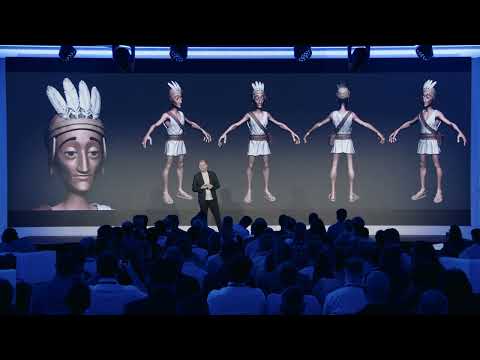

Digital heritage consultant Thomas Flynn gives a broad overview of where galleries, libraries, archives, museums and heritage sites stand with 3D. Thomas covers the trends (ultra-high-resolution capture, paradata, memory twins, storytelling and heritage at risk) and the challenges and opportunities around diversity, accessibility, citizen digitization, data platforms, open access, standards and sustainability.
“it's not enough to just say, "Here's a 3D model." You want to be engaging people and delighting them with 3D experiences”
“the memory twin is about digitizing the, the stories at the same time as you digitize the physical thing.”
“They end up kind of making 3D models or commissioning 3D models, and then they sit on a hard drive.”
Thomas Flynn describes it as a concept from the Digital Heritage Research Lab in Cyprus: digitizing the narratives, images and interviews connected to a subject at the same time as its physical form.
According to Thomas Flynn, paradata records how, and why, something was digitized, so that a researcher decades later can judge the quality of the dataset and what was included or left out.
Thomas Flynn said it depends on their technical understanding: with newcomers you may need to build up to why it is useful and what it achieves for that person and organization.
Transcribed automatically (ElevenLabs Scribe) and lightly edited. It may contain small errors. Click a time to play the video from there.
Thomas Flynn: Thank you. Cheers. Thank you very much for the welcome. Thank you, Thomas, for the information... uh, the, uh, invitation to come and present.
Thomas Flynn: Um, I'm here to talk about cultural heritage in 3D. Uh, I'm not here on behalf of a company. I come as myself, but also just to talk generally about the cultural heritage sector, and obviously these are the things that I'll be talking about. As I listened to presentations this morning, um, I think it's interesting to consider kind of comparing the cultural heritage sector, so galleries, libraries, archives, museums, cultural sites, and how the concept of digital twins can be applied to collections as well as, as sites as well. The heritage sector, I'd say, is kind of in some ways behind, um, the, the, um, reality capture sector, if, if we can broadly define them that way, in terms of technology, um, also funding.
Thomas Flynn: Um, but also cultural heritage is a very universal, um, interest I think. So hopefully this will be interesting to, to you. I'm gonna be kind of talking very broad general topics. Um, and so yeah, without further ado, this, um... a lot of this presentation actually w- is based upon something I presented in Cyprus a while ago at something called the EuroMed Conference and, uh, it was my first time, uh, in Limassol, and as I walked around, I took a walk around the city and I took a couple of pictures and, and I just bring them up to kind of, uh, share an idea of kind of what digitizing in 3D is kind of all about.
Thomas Flynn: On the one hand, it's about preserving, um, cultural content, um, and, you know, conserving, preserving, repairing, but also for building something new for future generations to, to use and to interact with as well. Um, and they just happen to be buildings, so that seems a bit relevant to, to today. Very briefly about me, uh, I'm a consultant. Um, I edit something called the Spatial Heritage Review. There's a LinkedIn group if you're interested in any of these topics.
Thomas Flynn: Please do, do subscribe there or join the group. Um, there's lots of other people working in this space that you can get to know and meet. I co-chair something called the IIIF 3D Community Group. More on that later. A visiting fellow at Bournemouth University in the UK, so I live in Bournemouth in the UK.
Thomas Flynn: Um, and I co-authored something called GLAM 3D, which is a white paper introducing heritage organizations to 3D. Uh, previously, uh, worked at Sketchfab, co-founded something called Museum in a Box, and did some 3D digitization for the British Museum. Um, just a very brief look at some things I've been doing recently. Um, over here, um, digitizing temporary exhibitions, uh, for the fashion department at Bournemouth Arts University, um, Gaussian splatting. Um, this is working with, uh, an art gallery in London called the Courtauld Gallery, um, for conservation purposes, as well as engaging audiences with their collections.
Thomas Flynn: And then this is something that's a bit of a bigger project, looking at, um, creating a memory twin, and I'll talk about that later, um, of a space in London called The Guildhall, uh, in collaboration with UCL and Cradle of English. I'm gonna try and whiz through 'cause often I, I run out of time. So if I start running out of breath and collapse, you'll have to come and pick me up. Um, also I want to just start with kind of sharing an idea of like, well, why is 3D relevant to cultural heritage organizations or, you know, the sector in itself? This is a, a big wall of text, but it kind of-- I wanted to condense how I feel about it into one, uh, sort of paragraph.
Thomas Flynn: So in far in the future, I would dream of there being a globally representative library of openly licensed, interoperable, well-optimized cultural heritage 3D assets, which are powering online mobile-first storytelling, experiences that educate and delight audiences with cultural and historical knowledge, all underpinned by interlinked archives of high-quality datasets sustainably stored for future generations. So that would be kind of like my dream. Maybe you in the audience have, have similar dreams or, or different dreams. Oh. So how it might work is, um, and we have to kind of read this slide from bottom to, to top, is that you have these high-quality datasets.
Thomas Flynn: So, um, this could be collection objects, and the heritage sector works with all kinds of collections from, uh, manuscripts, insects, paleontology, zoology, cultural heritage in a, in kind of a anthropological sense, buildings, um, monuments, et cetera, digitized in 3D. And the dataset will include other things, not just the 3D data. But if it's all done very nicely, on top of that, you could then make those assets available through a library of sorts. Um, and that, that library potentially could be openly licensed so that anyone could use that cultural content, uh, and interoperable, so you could use it in different 3D environments and for different, uh, purposes. And that underpins, um, the engaging and delightful, and, and those are the two things that I, I like to always push with cultural heritage organizations is it's not enough to just say, "Here's a 3D model."
Thomas Flynn: You want to be engaging people and delighting them with 3D experiences that maybe are educational, but maybe also just entertaining. So again, back to the trends, opportunities, and challenges. One trend, uh, is the, the interest in scanning, uh, or digitizing at the highest resolution and to digitize as much as possible. So just some, some examples of what that might mean. Um, some photometric stereos.
Thomas Flynn: So this is 2.5D, shall we say, uh, digitizing, um- A tapestry, um, something called Kintsugi 3D, digitizing not just the, the 3D shape, but also digitizing the specular, um, properties of a subject, uh, out of Minneapolis, uh, Institute of Art, somebody called Michael Tetzlaff working on that. And a project from the British Museum, uh, digitizing using photogrammetry under different lighting conditions, so UV, um, and infrared, um, and also CT scanning a, a subject there. So digitizing kind of as many aspects of a particular subject as possible, so creating lots and lots of data there. And this could obviously just...
Thomas Flynn: Th- this-- these are objects, but it could be, um, buildings and, and sites that are, you know, outside as well. We also have this possibility now, uh, using different techniques, for example, Gaussian splatting, to digitize, um, intangible heritage, so processes, um, in 3D or, or 4D, you might call it, as well. So it's now possible to capture more things in more ways than it's ever been, uh, before. And along with the, the spatial data, the 3D scans, there's the metadata, which tells you about the, the 3D models, you know, kind of the, the data sheet of a, a 3D file, and, uh, also more, more information about a particular subject as well. Um, another keen, uh, topic, it's kind of split from metadata, is the concept of paradata to record how something was digitized in 3D, so that when, uh, a researcher a hundred years in the future comes back to look at a data set, they can understand the quality of that data set.
Thomas Flynn: They can understand how it was made, why it was made, maybe what was left out, what was included. And this makes it kind of a more useful, um, set of data. Coming out of, um, the Digital Heritage Research Lab in Cyprus, um, is a fairly new concept of a memory twin, and this is the idea that when you digitize something, you're not just digitizing the form, uh, of the, the subject. In this case, it's a, a fishing trawler, um, from Cyprus. Um, and you can, you can explore this, um, at elambousa.
Thomas Flynn: eu. But you digitize as much narrative content, uh, and other related content to that subject. So you bring it all together into a nice package, whether that's, uh, imagery, um, or interviewing people that have actually engaged with, uh, a particular subject. So this idea that the memory twin is about digitizing the, the stories at the same time as you digitize the physical thing. Beep.
Thomas Flynn: As we make all this data, which is, which is really great, so this is a really confusing chart, but things get more complex. And I think, in general, 'cause I like to think of, uh, all audiences for 3D, not just professional or expert audiences, the more complicated things are, the ease of use and reuse comes down, and potentially the, um, audience size comes down as well. So if we want to engage as many people with, uh, 3D data, we want to make it, uh, usable and accessible, um, but maybe use optimized versions of the data to point towards the, the real meaty, um, data sets that are the more complete. Another theme, another, um, trend i- is obviously storytelling. Um, and I've, I've bundled this with heritage at risk because it's kind of a way to tell, um, more contemporary stories as well.
Thomas Flynn: So stories in general, that's why cultural heritage organizations exist, uh, and why they digitize things, is to enable them to tell stories. Um, and that could be the narrative of, you know, a particular thing. How did it-- How was it created? What happened to it? Um, why did it end up in a museum?
Thomas Flynn: But also kind of the storytelling through kind of educating people, using stories rather as education, uh, and communication. And then you ca- can ask, well, what stories can be told, and who's telling the stories, um, and is it just the kind of the, the people who have been telling stories for years, or are you opening it up to other people to tell stories, uh, if that makes sense, that maybe haven't had a voice before? Um, and are we addressing kind of the most powerful stories and using these technologies to, um, to talk about climate change and conflict, decolo-colonization, inequality? And that kind of goes back again to holistic digitization and memory twins. And then how do we present that, uh, offering interactivity and agency for the end user to really kind of, uh, experience stories, uh, in a new way.
Thomas Flynn: One particular, uh, method of storytelling that I'm quite a fan of is something called scrollytelling. Um, I can share the slides. There was meant to be a slide with a QR code at the beginning so that you could open this, but, um, it's missing. But these are all scrollytelling experiences where the, the user experience, or rather the user input that's required, is just scrolling. And I think that's a, a great way to introduce, again, non-expert people to 3D data.
Thomas Flynn: Because if you've ever seen, uh, somebody completely new to 3D engage with a 3D model, you, you've probably seen people zooming inside a 3D model, getting lost, not understanding kind of necessarily how it can be engaged with. But I think most people understand scrolling. And these are all really great, um, uh, examples from the Getty, from the International Commun- uh, Committee of the Red Cross, New York Times, and ABC Australia. So, um, do have a peep at those if you have time. Um, and yeah, going back to that idea of, you know, which stories are told, um, and through recording and documenting, uh, that's one way that stories can be made available or attention can be drawn to them.
Thomas Flynn: So digi-digitization used to document and valorize heritage, uh, under threat of war, climate change, or you're probably familiar with what happened to Notre Dame In Paris and how 3D played a part in, um, restoring it. But a couple of projects that, um, I want to draw your attention to are the work of Karim Yahya, um, at OpenVL, um, digitizing Palestinian heritage, and then the work of Skeiron digitizing, um, heritage in Ukraine as well. Again, these are links that you can click through if you get hold of the presentation. Another theme is diversity. So this is, um, from a presentation I did a long time ago.
Thomas Flynn: Sorry, actually, if I go back briefly. Diversity, inclusion, and accessibility, these are three separate things. It's not, not one thing. Um, this is kind of just a snapshot of, um, museum users on Sketchfab, uh, from 2023. So you can see a large proportion are from the US, the UK, and then Spain, France, a lot of European countries, a lot of Western countries.
Thomas Flynn: So at the moment, I'd say that what is being digitized and made publicly available, at least on Sketchfab, but I think this holds, uh, true for more broadly across the sector, reflects the current norms, uh, and historical makeup of the museum and cultural heritage sector. So you can obviously see, see that there are parts of the world that are not represented in the datasets that are being produced now. So every day, every week, more data is added to kind of the, the global library that I was talking about, but it's, it's coming from certain places and from certain people. Um, one-- a project, if you're not familiar that, um, I'm a fan of, the Museum of British Colonialism, um, which is intended to raise awareness, uh, on the presence of detention camps in Kenya and the brutal history of the colonial period. And so they're not digitizing things because the things aren't there anymore.
Thomas Flynn: They've been torn down or, or, um, uh, destroyed, but they're using 3D to, um, platform these stories, um, and to rebuild them, uh, in a digital space. Accessibility. So there's kind of a few readings of accessibility we could, we could take, but one is simply making the data that you produce available. So for cultural organizations, you want to make it findable, accessible, interoperable, reusable, um, but also meet audiences where they are. I'm gonna skip on a little bit 'cause I don't want to run out of time.
Thomas Flynn: Accessible in the sense of, um, again, that idea of optimization, so making something as optimized as possible when you're putting it in front of an audience I think is very important. So simply being able to download it speedily or load it in a fast way. The same subject, um, two different file sizes, uh, can make a big difference to how people, um, engage with something or don't. And something we tried, uh, at Museum in a Box was, um, exporting physical replicas of museum collections to audiences that couldn't come on site. So this little box was sent to schools and care homes, for example, and you put the subject on the top of the box, and it talks to you about that particular subject.
Thomas Flynn: So the idea is that if you can't make it to a, a museum, you can still have a, um, a novel experience with that content and engage with it. You can also create your own boxes, record your own messages, and, and school students have done that in the past as well. There's a big gap accessibility in 3D viewer accessibility, so online. Uh, I think accessibility for 2D content online, for example, even just alt text, is, um, pretty common, but for, for 3D viewers, um, there's a big gap there, um, for screen readers, audio descriptions, keyboard navigation, game controller navigation, voice control. Ways for other people who are differently able to engage with this content, uh, is a big, um, uh, opportunity, and luckily, there are some people that are already working on that, um, in recent years.
Thomas Flynn: Citizen digi-digitization. I think this is a, a, a big opportunity that isn't made more of, uh, in-- by the cultural heritage sector is, um, massive amounts of cultural heritage data. If you give people an opportunity to create 3D models, so for example, using Scaniverse or probably CamLuma or even publishing on Sketchfab, lots of non-experts are drawn to digitizing cultural content, and they're putting it online, they're sharing it, um, may-may maybe even making it available under open licensing as well. So how can that be, um, brought into, I suppose, the more canon, um, uh, elements of cultural heritage? So how could a museum or a gallery or library incorporate citizen digitized content into their own practice?
Thomas Flynn: Spatial data platforms, I'll just point, point out these. So what-- you make all this data, and then where do you put it? Um, there are lots of different options. Most organizations, in my experience from the cultural sector, don't have a great data preservation plan when they create 3D. They end up kind of making 3D models or commissioning 3D models, and then they sit on a hard drive.
Thomas Flynn: Not all, but, but often. Um, but there are other options. For example, submitting data to OpenHeritage3D, uh, where you can download these datasets under open licenses. Oh. Um, there's some nice work, um, dynamic collections, um, offering access to, uh, collections from across Sweden, but also kind of making visible some of the, um, the metadata related to them.
Thomas Flynn: Global Digital Heritage are doing great work. In fact, they were-- Somebody mentioned Petra as one of the sites they'd like to see digitized. I know that GDH have been, um, in Jordan, um, digitizing recently, so maybe that will be on their list. Um, Europeana 3-3D Big Data Space, that's another ongoing development in the EU to create a kind of a, um, an online database of 3D content, uh, available. And then the European Collaborative Cloud for Cultural Heritage is also another place that's kind of in the works for, you know, where everyone in the EU, EU could put their 3D data.
Thomas Flynn: And similarly, UNESCO is working on something, uh, for the Arab states, um, called Dive Into Heritage. So if, if these are all kind of, of interest, do, do take a look. But then the idea eventually we have kind of a global-- access to a global library of, um, of 3D content that we can compare and contrast collections across time, um, and space. And that data maybe is made available for, for reuse so people can download it and, uh, access that data and reuse it in their own ways. Um, it als- you know, this process of I make a 3D model, I put it online, I let people download it, y- there's a, a process of acknowledging the rights inherent in, uh, a piece of heritage, whether that's a dinosaur fossil or an artwork, um, and navigating that.
Thomas Flynn: Uh, also there's an element of organizations relinquishing control over collections, especially for cultural content, um, that doesn't necessarily or has other cultural owners than a particular museum. So kind of-- it's, it's really great, and my-- I recommend everyone do this, um, depending on what kind of collections there are. But it can, it can lead to all kinds of reuse in academia or creative reuse. Um, I quite like this is just, um, a serendipitous reuse of a, a set of chess pieces that I had digitized. They're a replica of the Lewis chess pieces, but a, a researcher used them in, um, a mixed reality, um, therapeutic scenario where, um, people who are having difficulties rehabilitating their bodies could enter and play chess in, uh, mixed reality.
Thomas Flynn: I'm almost running out of time, so I'm gonna skip through. Standards and operability. Um, there aren't really any, but, um, they're kind of developing. Everyone seems to have their own standards. Um, these are some, uh, places that kind of, uh, are working on that.
Thomas Flynn: I'm running out of time, so we're gonna keep going. The IIIF 3D group International Image Interoperability Framework. Imminently, there will be a specification for publishing 3D cultural data, uh, interoperably, uh, and it work-- it's not connected to, but similar work is being done by the OpenUSD, um, group as well. I'm almost done. Ten seconds.
Thomas Flynn: One, one final thing, this idea of sustainability. Two readings. Is that data that we're, we're capturing now gonna be available in 100 years, or is it just being kept for, you know, until next year or until somebody drops the hard drive at their university or, uh, organization, excuse me? Um, but then also the sustainability of, um, the, the fact that we're producing and using a lot of resources to capture, process, store, and display 3D data. So how do digitization, uh, processes impact the climate?
Thomas Flynn: This is, uh, an area ripe for investigation. Um, and how do we rationalize that to ourselves when we're just producing loads of data and eventually, because we're using up all these resources, it's just gonna end up with the stuff that we're digitizing being underwater, uh, in a few years. I'll stop there. A little bit over time. Um, but I hope that's given you a bit of a, a scattershot of, of where, where the heritage sector is with rele- with regards to 3D.
Thomas Flynn: Woo. Yes.
Host: Let's give it up for Thomas. Thomas, well done.
Thomas Flynn: Thank you.
Host: Well done. Uh, quick question. One question. Uh, and before we actually get there, uh, Ramy Tamimi posted a comment: "Thank you for bringing attention to the cultural heritage of Palestine. Your efforts are seen and appreciated."
Host: So one comment over there. And one question: How do you explain the importance and future uses of controlled high accuracy 3D geospatial surveys to conservation-- uh, conservation professionals and guardians?
Thomas Flynn: Well, it, it depends. I think, um, in the, uh, panel discussion earlier, there was an, um, illustration of you have to talk to the right people about if you want to do this kind of work with them. So, uh, I've written that, that Open GLAM 3D paper with NYU as an introduction. It depends on what level you can go in. If people have technical understanding, you can obviously explain things a lot quicker.
Thomas Flynn: But if somebody's never engaged with 3D digitization or, you know, if you said geospatial to them, they may have absolutely no concept what that is. You may have to work them up to explaining why it's useful and why-- what, what does it achieve for that person, for that organization? And it, and it really depends on, on the scenario, I suppose. It's a bit of a non-answer, but that's I think the best way to, to answer it.
Host: Let's give it up for Thomas one more time, ladies and gentlemen. Thank you.

Digital Heritage Consultant
Thomas is a UK based consultant to the heritage sector offering services and advice related to 3D digitisation, online publishing, open access, storytelling, and interoperability. In this capacity he's worked with UNESCO, Europeana, Oxford University, Creative Commons, and many more organisations.…