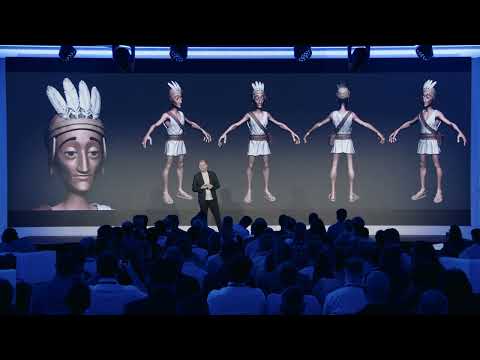

Alex Harvey, founder of VIBE, compares two ways to capture Gaussian splats: Meta Hyperscape, scanned with a Quest headset, and the XGRIDS PortalCam. Testing both at St. Mary's Church in Warwick and beyond, Alex shows how easy headset capture is, why being unable to export it was a dealbreaker, and how PortalCam scans with Veesus Arena4D became editable, shareable assets for heritage storytelling.
“It depends what type of money you're after.”
“But now there's a good enough point that we can make stories with it and visuals with it.”
“So massive down point here for Meta, the fact that I can't export the scan.”
No, according to Alex: Hyperscape scans cannot be downloaded, shared outside Meta's platform, cropped or edited, which is why Alex moved to PortalCam with PLY and LCC export.
Alex scanned a church in about half an hour with the headset, uploaded it to the cloud and got the processed scene back about three hours later.
Alex walked about 1,600 meters in one capture of roughly 54 minutes, which produced about 20 million splats after around 15 hours of processing on an Intel i9 24-core machine.
Transcribed automatically (ElevenLabs Scribe) and lightly edited. It may contain small errors. Click a time to play the video from there.
Alex Harvey: Nice to meet you.
Host: Welcome.
Alex Harvey: Nice to meet you. Hi, everyone. I think next time, if Michal asks me to chat again, I'm gonna ask him who's going before me. I felt like I was back at Codemasters making racing games. That was amazing and stunning, and I'd love to, um, chat more about that.
Alex Harvey: So XGRIDS versus Meta, or PortalCam versus Meta. Let's get into that a little bit. Thanks for Michal and Tomas for inviting me. This is a church in Warwick. It's called St.
Alex Harvey: Mary's Church, and we do a lot of work there, so I thought it's a really good place to test some of this scanning out. Um, and obviously, the Hyperscape is being used in the Quest Three and XGRIDS is the new capture device I've been playing with. So ten years of 3D models. I'm addicted to photogrammetry, and it's my passion, and it's all I do at the moment. So the journey started with Polycam back in the day, and let's play this so you can see a few models.
Alex Harvey: But Polycam led into Sketchfab, which led into selling lots of different models, and it all came from passion. You're probably gonna see a lot of random objects on here. Um, but as we scroll through this list, my addiction started with Polycam. I had my phone in my hand, and I, saw the ability to capture photogrammetry models so quickly, and the pipeline was beautiful for me to go straight up to Sketchfab and just add a little price on it, and then I could press sell straight away. There'll be some people that probably moan at me because we didn't clean up the models that much or decimate them.
Alex Harvey: They just kept selling as they were. So that was the addiction for photogrammetry. Moving on. I always like to say, it's what the clients want to see as the end product. So it's not always gonna be Gaussians.
Alex Harvey: I know we talk about it, and I'm excited by it at the moment. But for example, here's the church again or the museum around the corner, and we're showing off here one of the exhibits that we've got in Warwick. We've currently got three, and we're looking to get more and more, and then hopefully we can double the price in London. That's the idea. The inspiration came from Apple Park.
Alex Harvey: When we went to the visitor center in San Fran, I saw that they had iPads and an, uh, a model of, uh, Apple Park. You hold the iPad over, and the model comes to life. So we're basically saying here that it's not always a Gaussian. This is traditional three D modeling with animation, um, and it's got the object tracking as well, so you can see what you're looking at. It-- This is the path of the fire of Warwick in sixteen ninety-four.
Alex Harvey: So the kids and adults go in, and they can hold the tablet and see the path and which way the smoke went and which way the fire went around the town in Warwick. We also have the stats in there, so it's feeding back all the time all the live data of who's using it, and it gets used a lot. So we're gonna release it as an app and put a little sticker on the side so people can take it home with them, and that's gonna be the model going forward. So I'll skip this. We'll go on to the next one, and we'll see it in action in the church around the corner.
Alex Harvey: The text says church on every screen. And sorry about the resolution. I had a last minute, uh, change of it. So here's the next one. It is same again, overlay, but you get to see the church through time, um, through all the different ages of time as an overlay.
Alex Harvey: And so it's photogrammetry over the top. This was actually a three D rendered model just from scratch. Um, and this is the bit that I like to say. I saw it on Thomas', his talk, uh, yesterday, and someone asked, "Is, is this stuff actually making you money?" And I always say to people, "It depends what type of money you're after."
Alex Harvey: So we've got three scales of money here. I'll show you what the three D has been doing for me. This is a dead pigeon. Sorry, everyone. But it sold for seven ninety-nine twelve times on Sketchfab.
Alex Harvey: So if you wanna make money that's small, get your phone out, start scanning everything like I did, and things sell like our friend pigeon. If you wanna make a little bit more money, then we can sell three D assets from historical sites into games like Puzzling Places. So here, we're looking at Ambrose Dudley, the tomb from St. Mary's Church. And it is inside Puzzling Places, and we're having a multiplayer game.
Alex Harvey: This is two years ago, actually. Multiplayer game, building Ambrose Dudley from scratch. The beauty here is the church got paid two thousand pounds to license it into the game. They were happy. I didn't take any money, but it was nice to see that that, that could happen.
Alex Harvey: I called it to the church an inanimate object. They didn't like that very much. But it's an object that doesn't do anything in their church. So for me, this is how we can get repeated things of a similar nature in the future. So if you wanna make a little bit more money, the resolution's a bit skew-whiff.
Alex Harvey: But although I'm now VIBE, my previous life was ten, sort of eight years at RiVR. Started RiVR, and we sold this. So we sold the company, and I exited. And this is now, um, going off as a training platform with LearnPro. Um, so here's my journey so far.
Alex Harvey: Sorry about the slide again. Codemasters, I was there for eight years making racing games, which is why I was so interested to see the previous video. It felt like I was back in the game making the trailers. My job was to crash the cars together in a game engine and then go back to the replay and play it start to finish, and then move the camera and capture all of the angles to make you buy the game. That was my job as a video editor.
Alex Harvey: Then we moved to RiVR, and now we're doing VIBE things. So when we first touched on Hyperscape, this was the moment that got me, when I stepped into Gordon Ramsay's kitchen. I don't know if anyone's ever done it in Hyperscape, but it absolutely blew my head off because I've been in photogrammetry for so long, and it was always a massive, long process to get the models into VR so that we could see it. When I did-- When I saw this, I thought, "No way. They haven't captured this so quickly."
Alex Harvey: And then I started playing with it myself and realized that it was as simple as that to capture. So this was probably mid last year when I started seeing these, these, um, Gaussians in a headset. And then Laura my wife, didn't see me for probably about three months because this is the view inside my headset of all my Meta Hyperscape captures. So there's so many different places we scanned, but the weird thing is you look a little bit odd capturing with this. You're not capturing with a camera.
Alex Harvey: You've just got the headset on walking around a stage or wherever you are, museum, church, alleyway. Sounds weird. Um, so I went mad with it, and we just went crazy with it. So I can show you a couple of clips here. We're gonna see what the capture process is like for the user inside a headset.
Alex Harvey: So I'm outside the church. It gives you three stages. It basically says to you, "How big's your space? Walk around it and show me your space," which is what you're sort of seeing here. "Let's see the walls and let's see the ceiling and let's see the floor."
Alex Harvey: And then it goes to part two, which is, "Let's get a more detailed capture. Let's see that bin from every angle." So then you go-- You look a little bit weird again, walking slowly with a headset on in the street. There's quite a few photos of me online, um, looking a little bit odd. But I couldn't find a part two for outside, so we skip to part three.
Alex Harvey: It's a really important bit for me that they, they include the ceiling. So if we're in here, you-- the user gets a really, uh, nice tutorial on how to capture the scene to make sure you get all the, all the view. Sorry, I wasn't pressing play. Okay. So for me, when I'm doing these sections, it's really important to get the trees from below because when the user comes back in, I want them to be able to have a real slow sort of parallaxy around the objects that are close to them.
Alex Harvey: I loved the fact that with the Hyperscape, you could get to see distance. It's almost like fake distance without actually having to scan all that distance, where before we had to photogrammetry scan the whole street. Now I just do a section, and it sort of cups it off. So yeah, people probably looking at me here looking a little bit odd. Um, let's go...
Alex Harvey: Okay. So then I went in the church and with the headset. I scanned, and it took probably about half an hour in the headset. And then play. This is in Hyperscape.
Alex Harvey: I was ab-- If the audio was on, there's me saying lots of swear words saying I can't believe that this is so fast to get the process back. But the process was upload to the cloud in the headset, and then about three hours later, Facebook did their thing, spat it back to me and said, "It's ready." I jumped in, started teleporting around. I'm like, "Oh my God, I can actually see around everything." I didn't think it would be so good.
Alex Harvey: I was shocked. And when we used to work with the government and the people that needed it to be completely realistic and millimeter accurate, there was a need for the accuracy. But now there's a good enough point that we can make stories with it and visuals with it. So as I exit the training world and enter the entertainment and fun space, I get to do stories a lot more. So that looks stunning.
Alex Harvey: It got me really, really interested in doing more. So Laura knocked me up a quick show reel today 'cause I was absolutely gutted that I couldn't show everything 'cause we've only got twenty minutes. So I said, "Quickly, let's do a little bit of a presentation of the things that have come in, that are projects we're working on." The, uh, everything you see here is Gaussians in a headset. Um, so we've got the Gunpowder Plot.
Alex Harvey: What else have we got? Um, it's a rapid, rapid capture to do these things. So for me, I thought it was rapid at the time, walking around with a headset, and then I'm looking at this now and I wanna talk about each scene, so I need to not look at the screen. Okay. Let's play.
Alex Harvey: Let's just let this play out 'cause it does look really good to be able to capture stuff. So yeah, I was very shocked and amazed. But as with everything, there's a few downsides to this looking amazing. If someone wanted to see it in the headset, I'd have to either go to them or get them to my house and put a headset on them, connect to the internet, load my Hyperscape, and put them in it. Or if they've got their own headset, I could invite them now 'cause they've just opened it up in Horizons, so you can share the worlds.
Alex Harvey: But look what happens when you're in Horizons. This is another scene by Facebook. There's a bit of talking. He was just talking random words to me, and I just landed in that scene. Um, and I just thought, "If I gave this to a client, this would not be what they wanna see."
Alex Harvey: So massive down point here for Meta, the fact that I can't export the scan. Sorry for anyone from Meta. Um, they actually worked with me when we were testing this, and they don't reply to me anymore. I don't know if I annoyed them on the internet, but we now can't download it. I can't share it.
Alex Harvey: I can't crop it. I can't edit it, but it's owned by Facebook. So I was looking for a new option. I needed to have a different option. So I put a few posts on LinkedIn and I said, "Is there anyone out there that can, like, lend me what I've heard about with the PortalCam?"
Alex Harvey: And there was. Matt and Mark from Veesus, I think they're at the back, amazingly jumped on my LinkedIn and said, "We've got a PortalCam. You can come and have a go with it. Use some of the Veesus software, Arena4D, and have a little play around." And so Mark came around the house, lent me the scanner, and I had three days to do my thing, basically scan lots of things.
Alex Harvey: It was the first time I'd ever seen it or played with it. So I went out and about, met my friend Callum, who's a tree surgeon, and he does a lot of historical sites around the UK. We went and did a massive scan with the PortalCam because Matt and Mark told me that, um, they've never really done a scan that's quite big. So I, I like that as a challenge, and we ended up doing a really big scan. So a few more pictures of it in location in the church.
Alex Harvey: This is the tomb again that we sold from the church. So I'm saying to the church and all the other historical sites that we're signing up now, they can all do the same thing. They can all monetize inside and out their digital twins. I'm gonna go a little bit faster through this, but this is obviously filmed on the Meta glasses. It's a really good way of showing everyone what the user sees when they're doing these PortalCam scans.
Alex Harvey: So sorry if I'm walking a little bit too fast. It was slow, it was slow enough, but it was me learning. This is my first scan that we did. Um, and then it went into Arena4D for tweaking and playing. So Matt, I was am- amazed at how many different things you could do inside Arena4D.
Alex Harvey: So he started doing animation and adding the weather effects and lighting. And then we go through, and we start seeing a bit more animation. The main thing I liked in this bit of the software was I could crop it. I could crop and make things smaller and get rid of any bits that are around the outside. Obviously, something I couldn't do with Hyperscape.
Alex Harvey: Um, so yeah, animations. We did inside and out of this church. Um, these are just screenshots from inside Arena4D. And then we've got another video flying around it. And this was literally done sort of-- We had the scanner last week, and I processed some-- The guys were processing some of the scans, and this was the output over the last sort of two or three days.
Alex Harvey: This was interesting to me. They've added sky box and lighting and then the lighting behind the church. It was really cool. Um, yeah, and weirdly enough, just behind here, I used to live when I was a child. So I'm literally scanning my childhood, uh, town.
Alex Harvey: This was the screenshot that basically says, if I scroll down a bit, there's even more. We managed to do about, um, seven scans in three days in different places. Um, interestingly, we also went to McDonald's, which I'll show you shortly. But I've got friends in the art world, so let's go and scan a bit of street art. So we went to grab that.
Alex Harvey: PortalCam. Um, and then they were showing me the lighting again in the background. Really cool to get the instant visual. It goes into-- out of LCC, so the XGRIDS software, into this. Then I was playing with it straight away.
Alex Harvey: Um, let me go again. Nice big image. It's nice to stand next to this. Um, I need this at home, so we can do presentations for this. Then we said, "I've got a friend that works at McDonald's."
Alex Harvey: And I thought, well, he's got a meeting with the CEO at the end of this month. So I said, "Shall we do her a nice wow demo?" And he said, "Yeah," and he gave me some money. And so I went and made a 3D film about his staff and how they like working at his, this McDonald's. And as an extra, I'm gonna give them a 3D scan of a McDonald's in a headset in her demo.
Alex Harvey: She's gonna watch a video, and then she's gonna see the model in front of her and to be able to look around it. So that's why we did this scan inside and out. Now, let's push this, push the scanner. I thought, "How far can we push it?" I, I heard from people before that they did, like, a twenty-minute scan, and I thought, "Let's try and get a little bit more."
Alex Harvey: So we managed to get one thousand six hundred meters walked. Um, and Callum took me around, I forget the name of the place. But we went and scanned lots of trees and look at the area. So we started down here on the left, walked all the way along to here. This data was also being processed while we were here in Prague.
Alex Harvey: So I've literally was at the back of the room earlier sorting this out because they were just dropping me screenshots last minute. So Scott Gibson in the UK, amazing for the help, and Ian Jenkins as well, massively helpful. Um, so here's a little video. Fifty-eight minute capture. It was actually fifty-four.
Alex Harvey: Twenty million splats. Fifteen hours render time. Intel i9, twenty-four core. Short video. We've got another little video after this.
Alex Harvey: Um, but it's nice to see all the areas that I walked were really, really detailed. Obviously, it gets sparser as you move out, but there was no set goal for me to scan anything in particular. Just walk as long as-- as far as I could. We'll go through because I think there's better video to see. Cool.
Alex Harvey: PortalCam capture. This is a one-minute video, and it really does show off... I think this does have a little bit of audio, but this does show off the, the, yeah, the area in which you can scan a lot more. Um, it-- The, the scanner was absolutely fine scanning this. I was walking around taking screenshots and talking.
Alex Harvey: I had my glasses on, so I was filming lots of it. It ended up, for the three days, I ended up just, um, going to meet people, talking to them while scanning with the glasses on and just making content and capturing stuff. So it was, it was basically a test to see how far we could push this scanner. And now, obviously, there's a, the new one released. They like to push it again.
Alex Harvey: And I think already the Veesus guys in Arena4D already supports the LCC2, and they were sending me web links to look at this data on my phone. And my head, mind was blown with I can actually share this with people straight away. Okay, big capture. Let's do some more of that. And they look amazing.
Alex Harvey: Okay, so that's the Gaussians in there. It, it was... That was my gateway drug, I think, and now I'm fully addicted. I've moved from photogrammetry and phones to headsets and Gaussians and XGRIDS scanners, and now I fly drones and stuff as well. So I already wanna get the XGRIDS cam, uh, scanners above the trees, and let's, like, film them from above and let make a better model.
Alex Harvey: Um, and this, if you turn the audio up on this-
Host: Remember with this scanner-
Alex Harvey: I had to stop scanning
Host: with the XGRIDS scanner.
Alex Harvey: Because I was at this place in Coventry
Host: That on the side here, it says no photography.
Alex Harvey: And it was no photography allowed. And I hadn't got any permission. And so I thought that was the end of it. That was literally what stopped me from scanning, was the fact that-
Host: I don't think we're allowed
Alex Harvey: No more
Host: Scanner's not allowed in this one.
Alex Harvey: Not allowed. So here's the main bits about the comparisons. Yeah, this is the main bit. So for me, it is so much better to have the ease of the PortalCam. To be able to export in PLY and LCC is amazing.
Alex Harvey: The Hyperscape stuff is fun, and it's really good for people to capture things really quickly in a headset. Um, and you see people like Casey Neistat, on their Instagram profiles, they now show links to their spaces. So Casey's put his headset on, scanned his space, shared his experience on Horizon, and then on underneath his name on his Instagram, you click it, and you're in his apartment just walking around. So those things are nice if you... I don't know.
Alex Harvey: I think it's gonna be better in the headsets maybe for younger people, and the professionals are gonna use s- more, uh, bigger scanning devices. Um, and so where are we going in the future? This is at home testing Gaussians in Apple Vision Pro and on Meta Quest. So here is the Vision Pro. But the fact that we can just drop them straight into headsets, there's a little bit of background work in, but now it's turned out to me that the PortalCam and that route is now an- just another way of collecting amazing three-D assets, putting them into, I call it buckets.
Alex Harvey: So now we can just have loads of buckets of content. Some of it's two-D, 3D objects and videos. And now we're just gonna start creating experiences for people. So when I talk about the future, we're working with Warwick Castle and the Lord Leycester Hospital. And that's my, that's my thing to scan.
Alex Harvey: Um, but we're working with all those people to try and push the limits of their... We wanna historically scan all these places but also make stories there. So for example, at the castle, they have actors there already. And we're gonna film the actors, make experiences, and then allow people to, while they're visiting, experience something a little bit more while they're there. But while you're at home, you'll be able to download something, uh, like an experience on Vision Pro, to visit Warwick Castle virtually and not have to actually go there.
Alex Harvey: So for me, Hyperscape was really good to get into it, but it's not gonna be the way that I go in the future. I will only use the headset now for hosting my own experiences and my own builds. Um, but yeah, thank you for inviting me, Michal. It's been ama- uh, the only thing that I wanted to do was obviously speak about more things. So maybe next year we can talk about some more stuff.
Alex Harvey: It has been amazing actually, to be in a space with all these people because it's the only place that I actually feel comfortable around people like this. If we're doing a demo somewhere, I feel a little bit, like, trapped and a little bit like I've got to, uh, behave, not show the dead pigeon. But here it feels a little bit better. Thank you.
Host: Thank you so much.
Alex Harvey: Really good.
Host: Alex Harvey. We have time for one question.
Alex Harvey: Okay.
Host: Alex.
Alex Harvey: I went over.
Host: Um, so a quick one. Can you scan with four headsets at a time mounted on a big stick?
Alex Harvey: No.
Host: No? Okay. Uh, very cool.
Alex Harvey: Maybe if you made some code to do it. Maybe.
Host: Mm, okay.
Alex Harvey: I wouldn't know.
Host: How did you feel after using your hats, uh, sets to scan for half an hour?
Alex Harvey: Mm. Uh, I'm used to staying in VR for about an hour.
Host: An hour.
Alex Harvey: And so it's absolutely fine. Yep.
Host: That's it.
Alex Harvey: Good.
Host: And the last one. What is the platform you prefer so clients can actually monetize on a scan?
Alex Harvey: Uh, I only handled Sketchfab for monetizing, uh, objects. I wouldn't know where to recommend. Uh, I'm just gonna make my own apps to monetize it.
Host: Got it. Got it. Ladies and gentlemen, Alex Harvey. One more round of applause.
Alex Harvey: Cool. Thanks.
Host: Thanks.

Co founder at RiVR
Exited RiVR following acquisition by LearnPro Group | Now building VIBE pushing reality capture to cinematic extremes for next-gen spatial experiences