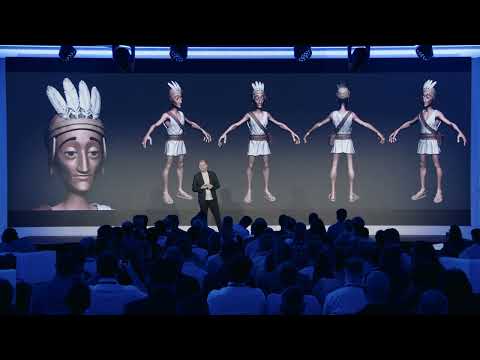

Moderated by Michal Gula, panelists from Radiance Fields, Epic Games' RealityScan, Overhead4D and Pixomondo discuss how Gaussian splatting is used across geospatial, real estate, film, games and heritage. They cover who is adopting it, its limits, accuracy and measurement, plans for RealityScan, and practical capture advice, with live audience polls along the way.
“what's really nice about Gaussian splatting is that you can create the data necessary for it from any 2D camera.”
“that's always my point to a Gaussian splats, that you should think about layering. That's a layer.”
“I must say this is all hacking. It's not like a native support.”
Michael Rubloff explained that data for Gaussian splatting can come from any 2D camera, and the scene is represented by 3D ellipsoids splatted onto a 2D canvas, which produces a lifelike view of what was captured.
Tomas Barnas suggested treating splats as one layer next to point clouds and textured photogrammetry and measuring on the laser scan layer, while Michael Rubloff expects measurement from splats to improve this year.
Tomáš Mišura said Epic is working on an easy splatting experience inside RealityScan, and automated pipelines are already possible through its gRPC plugin and CLI together with research tools.
Transcribed automatically (ElevenLabs Scribe) and lightly edited. It may contain small errors. Click a time to play the video from there.
Moderator: Thank you. We, we need one more chair. Thank you. As you certainly know, guys, uh, we were communicating this, that the 3D Gaussian splatting should be a main topic of, of this event. So, uh, it's always interesting not to just, uh, hear the, the advantages or the features from, from one point of view.
Moderator: I love where the-- when there is a discussion with different point of views. So even this panel discussion, we were trying to, uh, set in, in a way where people with skill and knowledge about 3D Gaussian splatting are coming from different kind of industries, so that we can discuss and, and see how each ind-industries is working with it. So with that being said, let me introduce you here, uh, Tomas Barnas from Overhead4D. Uh, Matej Kosovsky from, uh, Pixomondo, part of Sony. Tomáš Mišura, uh, Epic and RealityScan.
Moderator: And Michael Rubloff from Radiance Fields. Uh, guys, I, I already said that you are coming from different fields, so I hope you will have different opinions on, on the 3D Gaussian splatting. So my very first intro question would be, what does it mean for you, especially with-within what you are doing? Maybe we can start with Michael.
Michael Rubloff: Yeah. So for me, um, this consumes my entire life essentially. You know, uh- ... every single moment of my day revolves around, uh, either Gaussian splatting or any of the Radiance Field representations and really, uh, profiling and cataloging where they're being used out in the world, both on the actual, like, um, production side and, and to the research world as well.
Moderator: How, how deep are you going with the, with the research? Because you are famous for the saying that there is, uh, every five minutes there's, there is a new paper regarding the 3D Gaussian splatting, right?
Michael Rubloff: Yeah. No, it's definitely gotten progressively more difficult to keep track of, um, the individual papers that are coming out because it's the, the frequency is still kept up in terms of the amount of research interest and, uh, on top of that now, there's even the actual, uh, shipping of, of products out into the world. So it's been really fun to actually follow along with some of the developments on the research side.
Moderator: Mm-hmm. Mm-hmm. Uh, Tomas, uh, we already mentioned the, the, that you are coming from, from Epic and RealityScan. Uh, for those who might not know it, it was, like, two years ago when it got renamed from RealityCapture.
Tomáš Mišura: Yeah.
Moderator: So for those who has been in, uh, photogrammetry long, that's the company, okay? And then these guys is from, from it.
Tomáš Mišura: Yeah. We, we had a website called Capturing Reality. The product was RealityCapture, and we renamed it to RealityScan, so it's more streamlined.
Moderator: So if you are mixed, it's okay. You're supposed to-
Tomáš Mišura: No worries. Me too.
Moderator: So what does it mean for you, uh, the, the 3D Gaussian splatting?
Tomáš Mišura: Yeah. For me, uh, I have a little bit of deja vu because, uh, I have been in this field for, uh, quite some time. And, um, even photogrammetry has been kind of a second cousin, um, next to laser scanning, uh, and nobody took it seriously for even metrology purposes. And it took a while to really, like, build, uh, something around photogrammetry. And for me, it's really important that, um, Gaussian splatting is now kind of the new technology or even any form of radiance fields, in my opinion, are kind of popping up.
Tomáš Mišura: And what we are trying to do is to support this and, uh, also help with, uh, democratization. So, um, as you might know, RealityScan is, uh, one of the state-of-the-art, uh, structure from motion engines, which is really important to, uh, have nailed. Uh, for any kind of capturing purposes, y- it might go wrong, so you really need to have really good, uh, registration done. And afterwards, well, what we are trying to do is to open this to any company, um, or tool, uh, where you can create a Gaussian splatting. Um, you know, there are PostShot, LichtFeld, you name it.
Tomáš Mišura: You can even vibe code your own right now. So, um, opening this to everybody is really important to support the democratization, in my opinion.
Moderator: Uh, Tomas, the second Tomas Barnas, uh, you already had a great speech, great presentation. Congrats again, uh, to that. It's, it's a huge project and, and it's a great, it was a great presentation. Uh, you already mentioned that, uh, you look at the 3D Gaussian splatting not as something that would be sell-sold directly, but as a part of, of the development. So how do you feel?
Moderator: Because I remember these, uh, talks between us long time ago because he, he's, um, he's a, uh, I, I like to call him a demigod of photogrammetry because he has been doing photogrammetry before it was cool. So I, I, I like to ask you like, uh, how do you feel? Uh, are you going to switch for, from, from photogrammetry or what, what place does 3D Gaussian splatting has in, in your business?
Tomas Barnas: For me, that's a natural development. So something like Tomas said, like there are always times when something new is popping up. Like we have AI, we have other things which are then suddenly kind of like hype or, uh, people are trying to check it and be involved and see how it goes. But for me, this is a part of development and, uh, part of every project and, uh, as I said, like development of the future because you can't just stay with the technologies you are using for 10 years. If there is something 10 years, there must come something what is new.
Tomas Barnas: And, uh, this is for me, Gaussian splatting that it-- we just actually used exactly the same pipelines. There came just suddenly another processing tool which help us to create another kind of data. We have to, uh, involve our processes to figure out how to implement them, but it's not about like thinking differently or looking at it like it's something totally new. It's more a development of something what we, I would say like all of us, uh, have used and, uh, we just need to be open to bring it into our pipelines and then try to gain from it the good, uh, or the good thing for you. It doesn't have to look like entirely good, like what I just said in my presentation.
Tomas Barnas: It's more about, for me, about using Gaussian splats there where we need them. So we still combine everything. We do laser scanning, we do photogrammetry, but we never could have such a good backgrounds, backdrop scenes without Gaussian splats. And this is just something what is helping us to create a unique experience for the same amount of work or even less, but enhanced and better.
Moderator: Perfect. Uh, Matej, you're coming from, from Pixomondo, from basically a filming industry. You specialize on, on, uh, special effects. Uh, it's interesting that we are speaking about the same technology and everybody is using all of-- or there are many various ways how to use the 3D Gaussian splatting. So what does it mean for you in, in your industry?
Matej Kosovsky: Well, I have to agree with what Tomas said just now, that it, uh, removes a lot of barriers, uh, from the technical aspects that photogrammetry had before, and this broadens up the use case. So you can utilize it on film, you can utilize it in games the same way. But before we had to do a lot of the technical stuff behind, so the games had to be optimized. But now it's like a level playing field, and it's very simple and easy for people to understand because it looks so photo real. So even if you are delivering it to different clients, it's very easy to explain to them that this is the result that we can achieve now, and it doesn't matter how it's done.
Matej Kosovsky: It's just this is the new frontier that is possible.
Moderator: Uh, perfect. Uh, before we were preparing for, for this panel discussion, we had a, we had a talk with, uh, with Tomáš Mišura, and, and he has a question actually for you guys. Okay? So get ready, uh, with your phones and, uh, it's, it's, it's your time to, to ask the question.
Tomas Barnas: Yeah. Can we put it here? Yeah. Have you used Gaussian splatting in your work? Uh, so this is like a warm-up question.
Tomas Barnas: So, uh, how you feel about this? I think this is a really important topic. Uh, people are talking about it, full LinkedIn, you know, there, there are so many posts about it, but have you actually tried it out? Have you got your hands dirty?
Moderator: We will wait for a few seconds more, but there is already more than 70 responses. You really want to win something, apparently. And it's almost... Yeah. It's over 40%, 45%, 44% of people that have already experimented with, uh, with the Gaussian splatting, which is incredible because, uh, you can always meet even people from the industry that have like zero idea what's 3D Gaussian splatting.
Moderator: Then I'm always saying like, "Guys, you should pay the attention." Uh, typical bias that, uh, I'm confronted with is that many people thinks that it's a hype. It's just the hype like it was with the metaverse or like it was with, uh, NFTs or whatever. And I like to point out that here are people and companies that are, uh, quite heavy on, uh, in the industry, and they are seriously thinking about 3D Gaussian splatting and, and working with that. So as first 3D, uh, the, the radiance fields from, from, uh, Michael He's doing a lot of research.
Moderator: So could you just confirm, like, how big companies are, are, are taking seriously the, the 3D Gaussian splatting?
Michael Rubloff: Yeah. What's really nice to see is how it's, uh, generalizing across, uh, some of the largest industries in the world. And this includes, you know, AEC and geospatial with companies like Esri and Bentley Systems that are adding, uh, support for Gaussian splatting. And we're also seeing a lot of these governing bodies as well s- such as, like, the Khronos Group and, uh, the Alliance of OpenUSD, for instance, also creating these standards for Gaussian splatting. But when we take a look at other industries too, you know, there's definitely a very large interest in the hospitality and real estate world, where we have companies like Zillow that are now, uh, have added Gaussian splatting support through a platform called SkyTour.
Michael Rubloff: There's also on the opposite, on the opposite side, there's the CoStar Group who owns apartments.com and homes.com. They also own Matterport, and they actually have a product now called Matterport 3D Exterior. And recently, I think just like a week or two ago, they announced that this summer it's actually gonna be going to be, uh, shipped to about 1,700 different su- uh, suburbs in Australia as just, uh, one segment.
Michael Rubloff: So it's starting to really make its way into that industry too. But definitely another really big application has been the media and entertainment world too, where, uh, for virtual production, you know, location scouting, this has been a very powerful tool for them, where they can start to actually visualize and preview their productions i- in a much, um, more cost-efficient way. But we've also seen it in the visual effects, uh, c- pipelines too, where there are examples that I'll show a little bit later today from the "Superman" movie last year, where every single shot of Superman's parents in that movie is not in fact 2D. It actually is complete dynamic Gaussian splatting. But we've seen, uh, examples from Sinners as well.
Michael Rubloff: Uh, for if you were wondering how they were actually creating a twin of Michael B. Jordan, they actually were creating a, uh, a, a Gaussian splatting reconstruction of him and using that to actually, uh, supplant from, from the performance. And, uh, other examples are "Dune: Prophecy" has also used Gaussian splatting. And one other thing I wanna highlight about the media and entertainment world is that it has a very long lead time associated with it. And so for the example from "Superman," this was completed, you know, over two years ago, but we only saw it last July.
Michael Rubloff: And so there's a lot more works that are taking place right now that just have not been released yet. But hopefully by the end of this year, there'll be a lot more examples for us.
Moderator: Uh, it's great to hear your opinion because you are in, uh, touch with a lot of these companies, so, so you can actually have it from, from the first hand whether they are working or not working on, on 3D Gaussian splatting. So thank, thank you for that. Uh, Tomas, you, you are coming from, uh, from, uh, basically a, a behemoth of, of, uh, photogrammetry softwares. Like, uh, um, I, I think that many of, of people from our audience were or are using the, the RealityCapture, now RealityScan. And so-
Tomáš Mišura: We are happy
Moderator: so so I'm, I'm just wondering how the such a big company as Epic is touching this point because it, it might seem that it's actually in a conflict, right, with, with so far what has been done with the, with the RealityScan. So how, how do you tackle this?
Tomáš Mišura: Well, it's one of the mode- modalities, uh, that you can use to, for storytelling. And, uh, um, I think it kind of narrows the gap between if you want to use, uh, a picture, you want to use a video, you want to use a HDRI, you want to use, um, 3D textured model, uh, done with a really precise techniques, uh, like, uh, the talk that was before with photometric stereo. Uh, you can do even obviously Gaussian splats. You can combine it with radiance fields and, you know, you can name it. Uh, you can try and use anything which suits your needs.
Tomáš Mišura: Um, I've seen a lot of utilizations also, thanks to Michael, uh, that is keeping me up with all of this, and, uh, it's just crazy. Like, you can really utilize everything. Where I'm really glad is also most of the time everything, uh, ends in Unreal Engine. So, uh, that is also something that, uh, is amazing. And what I can also say is obviously we are also working on, uh, solutions to improve this pipeline.
Tomáš Mišura: And, uh, yes, it's, uh, one of the important things that, uh, we need to tackle just to open this, as I, as I said, and democratize this.
Moderator: So I'm, I'm just guessing that, uh, Epic is not going, like, all in with the Go- Gaussian splatting.
Tomáš Mišura: No, not really. As I said, one of the modalities and, uh, it's not like we are going, uh, full throttle on that. But, uh, yeah, options are something that needs to happen.
Moderator: We already saw, uh, in the survey that, uh, more than 40%, uh, of people have actually tried, uh, 3D Gaussian splatting. So maybe you can ask your second question.
Tomáš Mišura: Oh, yeah. Let's do that. Um, this one will be, uh, a little bit more hands-on. Can we?
Moderator: Yeah.
Tomáš Mišura: So what do you use it for? Um, this is kind of open-ended. Be creative. Uh, sexy body was one of the good answers I seen in the last poll. But you know, anything.
Moderator: Try not to repeat the joke. Stop motion VFX.
Tomas Barnas: While we are, we are waiting-
Moderator: Archaeology
Tomas Barnas: I just wanted to mention one thing because we said multiple times that, uh, if you follow Michael or we saw it from Michael. So for those of you who are not really following it, that's not a promotion. That's just like Michael is really giving a lot of, uh, information and a lot of papers and all the stuff about Gaussian splats online. So if you're following him, you really will not miss the, the best news. So just heads up to this because I really...
Tomas Barnas: I'm trying to be informed. I'm trying to follow it myself. But, uh, yeah, it's, it's great to see always your stuff.
Tomáš Mišura: He also has RSS feed. Very important
Michael Rubloff: Yeah, no. As more, you know, uh, industries have started to add support and there's more examples, it's definitely become harder to follow, uh, the, the totality o- of its applications. But yeah, if you're interested to follow along, definitely would, uh, suggest it. But anyways, do you want to-
Moderator: For the record, uh, this is not a paid promotion of Michael. Uh, okay. So we have, uh, more than 63, uh, more than 60, uh, answers. So basically it seems like it's for VFX, cultural heritage, virtual tours, visualization, environment, visualizing existing buildings. Okay.
Moderator: Only scans. Is it something like OnlyFans or is, is very different? Not sure. And generally 3D. Uh, great.
Moderator: Thank you. Thank you for that. Uh, Tomas, we have a question. Uh, what are the main limitations of Gaussian splatting in general?
Tomas Barnas: Um, the main limitations of... There's still a point that you need to kind of decide what you want to do with those data. That means they're good in or from the views you are capturing. So you cannot expect something that, uh, that you're capturing from certain angle and then suddenly you want to have like top-down view when you are capturing it from, uh, front side or sides, uh, that you will get, uh, great views of Gaussians. So I would say like a negative part or limitations is that you need to think what you are doing and you need to know what you are going to achieve.
Moderator: Mm-hmm. Uh, Matej, when was the first time that you realized within the Pixomondo that, uh, we have to pay attention to 3D Gaussian splatting and tried?
Matej Kosovsky: I think as soon as it came out. We always try to stay on top of the latest technologies. And about three years ago, uh, we started with NeRFs and then quickly shifted fully to Gaussian splatting. And I think that's the same for everyone in the industry. Uh, in the poll, the biggest, uh, use case was VFX.
Matej Kosovsky: And I'm not surprised because usually a lot of demand is in this very hard to get industry. So similar to F1, you develop a lot of technology in that high end and then you distill it down to consumers. And I think that's same thing happening with Gaussian splatting, that you develop it with, uh, high budget and high quality and demanding clients, and then it's broadening up. So all the big tech industries now are having their own take on it. And that's something very powerful about Gaussians, is that not one company came up with it and holds the rights for it, but it's open source, so you can see a lot of these new integrations and developments around so anyone can use it and interpret it for their industry.
Matej Kosovsky: So it's very, uh, interesting to see how it's growing.
Moderator: Mm-hmm. Mm-hmm. Uh, I like to always say that, uh, 3D Gaussian splatting was not meant to be for the accuracy, for the ver- very high geometry precision and everything else, but we still can see a lot of papers that are trying to achieve this. So Michael, this, this is the question for you, like where do you see this going? Am I going to be wrong very soon with, with my expectations that 3D Gaussian splatting will not be accurate enough to measure?
Michael Rubloff: Yeah. So I think that if I had to make a prediction, I think the three things that will really, um, take a bit of a leap this year will be, um, one, relighting I think is gonna get a lot stronger and more capable from Gaussian splatting. You know, I, I think that also, um, on, on the measurement side too, we're going to see quite a lot of examples too, uh, from, from that, that world. And, um, yeah, I, I think that there's also a lot of really great research works right now. So some of, uh, of them would be like mesh splatting or radiance meshes is another paper.
Michael Rubloff: And there's another one I think that's called like from, uh, from like Spokes to Blobs, I think is what it's called. And, uh, that is also another really pro- uh, promising direction for the, the world of, uh, meshing from, from splats. So I, I think there's gonna be a lot of momentum over the second half of this year for, for those three challenges and, uh, will potentially change how we perceive or utilize their representation.
Moderator: Uh, we-
Tomas Barnas: I would, I would like to add to that question just because, um, this is very often asked and, um, also I would call it like kind of a bias from the, from the beginning that, uh, when you see Gaussian splat and you are used to, uh, have like precise la- laser scans, you're trying to divide these worlds. Uh, now we have already solutions which are combining LiDAR and creating Gaussian splats which are making them accurate as LiDAR is, let's say. Um, but even before that was happening, we tried to play with it in a way that we've created the Gaussian splats, but in parallel we created a laser scan with terrestrial laser scanner, and we were manually overlapping these things and matching them, uh, or like, yeah, overlapping them. That means if you find your way or if you think about it that there can be a layer which is helpful, then you can use it. And, uh, that's always my point to a Gaussian splats, that you should think about layering.
Tomas Barnas: That's a layer. You have a layer of point cloud, you have a layer of photogrammetry with textures, and then you have a layer of Gaussian splats. And then you combine them and use it for the benefits. So yeah, if you want to measure, then you will measure on the terrestrial laser, which is just one layer bel- below. So in that case, for me it's...
Tomas Barnas: This is a kind of a wrong question or just like wrong thinking because you can just rethink it and then you get the, the resolution you want or the accuracy you want.
Moderator: Uh, Tomas, we have a very direct question to you. Will Gaussian splatting be possible inside RealityScan?
Tomáš Mišura: Well, uh-
Tomas Barnas: I cannot say.
Tomáš Mišura: I can, I can say that, uh, there are kind of two sides of that. One is the training Then actually more of that. There is training, optimization, rendering, you know, editing, you name it. And, um, yes, uh, definitely something along the lines will be possible. Um, last year we published something that might have been like an unimportant release where we, uh, introduced gRPC plugin, uh, which is opening also doors to things like MCP servers and all of that.
Tomáš Mišura: We didn't really talk about it yet, but you, you can do a lot of things with that, uh, thanks to, um, other things in AI because you, you have full toolset with CLI, you have full toolset with gRPC protocol, Boling, all of that. So, um, yes, for like even automated pipelines, you can do it even right now. You just also need to help yourself with some GitHub repo, which is on the research side. Um, but for really easy user experience directly inside, uh, RealityScan, um, I can just say that we are working on that.
Moderator: Great. Uh, Matej, I know that, uh, you have been using, uh, laser scanning and photogrammetry mostly for like a preparation of, of the scenes, right? Uh, uh, have you been using this, uh, technology als- also like in a direct footage of, of the movies or?
Matej Kosovsky: For Gaussian splatting or photogrammetry?
Moderator: No, no, no. Uh, the first question is, uh, about, uh, laser scanning and photogrammetry because the follow-up, follow-up question will, will be like if, if the, if the Gaussian splatting is actually being used also within the films or again, just for some preparations.
Matej Kosovsky: Yeah. So there are multiple use cases that we have for this technology. Uh, LiDAR gives you the accuracy, so that's something that we use, uh, a lot as a supporting dataset. Uh, but it doesn't have the texture fidelity or the creative freedom that the movie industry often requires. So there needs to be some kind of artistic, uh, addition on top of that, uh, after the scan is created, uh, to make it into the final picture.
Matej Kosovsky: With Gaussians, we can use it directly as a output, so you can put it directly to the final picture because it is photoreal or it can be close to it. But because of the current limitations about the flexibility like relighting and other issues which are now being solved slowly, um, actually quite quickly I would say, um, it's going to be more and more involved in the pipeline and the workflows for everyone in visualization. And in terms of like what part of it it is, if it's at the beginning for previous or, uh, planning or it's final picture, I would say it's across the board. Um, starting with planning is the easiest, but because you don't have to use it at the end. But, um, if you plan well for a mission, uh, for capture mission, you can use that, uh, dataset in the final picture as well.
Moderator: Mm-hmm. Um, more than 40% said that they already tried, uh, which automatically means that the rest have not either because they didn't have time for it, or they didn't know how, or they just found out about the 3D Gaussian splatting. So maybe for those people, could you, Michael, just like in, in the most simple way explain what it actually is 3D Gaussian splatting?
Michael Rubloff: Um, sure. Like the, uh-- So basically Gaussian splatting is, uh, it's not the most approachable word, uh, or, or name for a technology, but I promise it actually is quite simple to utilize. Where what's really nice about Gaussian splatting is that you can create the data necessary for it from any 2D camera. So anything that's capable of taking a still image can create data necessary for it. So that can range all the way from a phone to a film camera to an IMAX camera.
Michael Rubloff: All, all this can actually reconstruct, uh, i- into 3D. And basically we have these three-dimensional ellipsoids, uh, kind of like almost like a American football shape, and we are going to essentially splat them or throw them against a 2D canvas. And instead of it looking just like a bunch of random paint splattering, it actually will represent a pretty, uh, lifelike, uh, representation of what has been captured. And some of the information that, you know, if you're trying Gaussian splatting and say it's not coming out very well, uh, one of the-- two of the things that Gaussian splatting really loves is it will see-- or sorry, it will reconstruct what it sees. And so if you are giving it very sharp and deep depth of field images, that gives it a whole lot more information to actually go and reconstruct the world.
Michael Rubloff: Uh, and so an example could be something like, uh, using a wider focal length lens because you're able to actually pull in more information per frame and you're getting a, uh, shorter hyperfocal distance too, so you can keep things in focus and make it nice and sharp. And the second thing that Gaussian splatting really loves is having these like multi-view perspectives and parallax. And so being able to actually feed it, uh, uh, opposing, I guess, uh, uh, images and being able to really showcase the full 3D scene or the 360 o- of a given space. But to the same nature, you know, there are cameras like 360 cameras that make this really easy to go and actually just pull in a lot more information about the physical world in the same amount of time. But, um, I would say, you know, just kind of really, you know, if you, if you start to give it sharp images and multi-view, uh, perspectives, that will really help your captures level up quickly.
Moderator: Mm-hmm. Uh, we have pretty much upvoted the question here, so I am going to ask, uh, not sure right now to whom it's going to be, but, uh, you pick guys. Uh, have any of you been able to get a good reverse models and assets, texture maps, or creating anything else from, uh, 3D Gaussian splatting yet?
Tomáš Mišura: So it's something what I have just, uh, mentioned previously. Uh, and, uh, this is for me the point when you are thinking about this technology may be slightly wrong
Moderator: Because creating Gaussian splats, it's not about creating textures. So that's, that's generally like a first point which I would, I would mention because we are speaking about colored splats, points. We are not speaking about painted texture, which is there for photogrammetry. So actually, it's very hard to answer because I would just rethink it, like do you use it as a layer, as something what, uh, you put in the background or next to it or overlap it with the textured model if you want, but you are not able to extract a model with texture from the Gaussian splat.
Tomáš Mišura: There is maybe one thing that I would say, and that is, uh, what I see across the industry is that people are generating meshes even from Gaussian splats, but to... for very different purposes that you would expect. Uh, they, they need to have collisions, for instance. So, and even for measurements, right? You don't really measure on that point cloud or even splats.
Tomáš Mišura: You can measure, though, on the mesh, which is below that as a layer. And, uh, obviously for collisions, you need to have some kind of primitive. Uh, so that is also another use case that is pretty common now.
Moderator: That's a really good point. But, uh, at the same time, if you need for collisions, you don't need very precise geometry, right?
Tomáš Mišura: Yes. They are two different kinds of meshes that you would need.
Moderator: So, so, so there is no need for a hunt for like very accurate, uh, output from the 3D Gaussian splatting into 3D meshes.
Tomáš Mišura: Even for optimization purposes, you don't really want to put there, you know, 5 billion polygons below that Gaussian splats. That would just not cut it.
Moderator: I would like also to dig deeper into the thinking of, of, uh, within the, the, the Epic. Because like first or of, or another bias that, that, uh, I like to mention always is that people from the very beginning, beginning were saying that you cannot use 3D Gaussian splatting within the gaming engines, right? Because, uh, you are used to work with 3D meshes or 3D models or primitives and so on. But you tackled it, it pretty easily, right? So you just adjusted your workflows within the Unreal Engine.
Tomáš Mišura: I mean, yes. I, I must say this is all hacking. It's not like a native support. You need to kind of, you know, twist it. Uh, it's not necessarily the real representation how it should look like, but what needs to be real.
Tomáš Mišura: In, in film, for instance, nothing is real, you know? And who will, who will get it that it's not? Does it need to be real? Well, these are all questions. For, for games, though, it's a little bit different.
Tomáš Mišura: People are used to do certain workflows. Um, even though you can now use Gaussian splats through VAP, it's still not, you know, that optimized to really run the whole AAA game this way. It's just lacking a lot of stuff right now. It's... but it's in the early stages, and I think it's, uh, something that I'm really looking forward to see how this will develop.
Moderator: Mm. Um, Matej, are you using also, uh, dynamic, uh, Gaussian splatting within VFX or you're just, uh, focusing on, on 3D Gaussian splatting, not 4D?
Matej Kosovsky: There is definitely a use case for it. Uh, different clients might demand that, but I cannot confirm or deny.
Moderator: Uh, unfair enough for our, our audience. Um, is there something right now, uh, from, from the feature point of view of 3D Gaussian splatting that you need and you are missing right now for, for your purposes?
Matej Kosovsky: The flexibility and the workflow adaptation. So the constraints that we have, or I think most of the creative industries have, is that we have existing workflows that we work with, and we have tools that we work with, such as RealityScan, for example. And if you are bringing a new technology, it must work with the rest of the system because, uh, you cannot just break the entire pipeline and start from scratch. So adapting it in steps or making a separate unit that is a part of the process is, uh, currently the way to go. But if you successfully implement it fully into the pipeline, that would be something that would help a lot.
Matej Kosovsky: So, uh, I hope that you maybe work weekends as well.
Tomáš Mišura: All day long.
Matej Kosovsky: Very good. Uh, there is the question that we can touch up on as well. Um-
Moderator: Which one you like?
Matej Kosovsky: The top one.
Moderator: The top one. Uh, can 3DGS be as precise as point clouds and meshes for measuring things on the models, or is it only for presentation purposes?
Matej Kosovsky: So I have a question back for that one. Uh, the reason why you want to use 3DGS or Gaussians in general, I think is, uh, you want to solve a existing problem. And my question is, do you have a measuring problem with existing technologies that you are using? Uh, because the reason why everyone jumped on it in visualization and previous is because getting things look realistic is very expensive, and Gaussians gets you there 80, 90% very quickly. So that was the clear improvement.
Matej Kosovsky: But maybe you don't need to use it for everything, right? Like if you have an existing, uh, method that you're using to get your clients the data that they need for, let's say, measuring, there is no need for you to adapt Gaussians for that specific, uh, use case.
Moderator: Uh, with that vice versa question you, you did, you, you could just, just do the mic drop because that was exactly, uh, the right, uh, response to that. Uh, Tomas, um, you know that, uh, you have always been trying to, to try things first and, and, and then do things that, uh, other people things are im- ... impossible. And I like to say that, uh, we ask people that think that something is impossible to move away for the people that are already doing this. And while people were saying that 3D Gaussian splatting cannot be used in, in, uh, gaming engines and in VR headsets, we did a project of us that we already used it, uh, within the VR.
Tomas Barnas: Yeah, exactly. That was, uh, shortly after some of the first, um, papers were released. Uh, and, uh, luckily, uh, we had a currently project for VR but streams to stream the V- VR. So that was different to my presentation where like with headset integrated, uh, VR, we still can't use properly the Gaussian splats because they need, um, more processing power. But, uh, once you need to share something, then you are able to bring it, uh, anywhere so far.
Tomas Barnas: So I would just say like, yes, exactly. Just think about it like what and which part of these you can use and, and, and use it as your benefit.
Moderator: Mm-hmm. Uh, Michael, uh, it-- th- this has something w- to do with the question about, uh, from, from the audience, how it will affect the inspection of, uh, critical infrastructure. I would like to add to that because, uh, last year with the TED we have seen the, the AI inspection on, uh, concrete on a, on the bridges. Uh, it was on a photogrammetry model. Uh, does this something somehow differ?
Moderator: Do, do, do you see in those papers some approaches to, to this?
Michael Rubloff: In terms of making it like as precise or being able to see like individual cracks or-
Moderator: Yeah. And ideally somehow automatically to idif- iden-
Michael Rubloff: Yeah
Moderator: identify them.
Michael Rubloff: Yeah. No, I think that that is very much, uh, likely to happen th- this year actually, is that, you know, we've seen a lot of semantic pairing with, you know, say like any of the radiance field representations where you can start to ask questions to the different systems or, or have it actually do the auto segmentation. You know, I think XGRIDS has like a demonstration of some of this in like real estate and construction as well, where we start to understand a, a given space or what's been captured. And, um, I also similarly believe that, uh, the actual capture path will also begin to be automated too, whether, you know, you are just feeding it, uh, multiple cameras walking through a space and then just, you know, reconstructing that. Uh, or what I've also started to see too is people will start to just realign in post and then, uh, use it almost like a digital flip book to go and actually see a space's progression over time to do either maintenance or asset monitoring.
Michael Rubloff: But, um, I think it's very, very likely that that will happen.
Moderator: Thank you. Uh, Tomas, this is, this, this is question for you, and, uh, I'm sure you won't be able to respond to this, so I'm going to ask you this. Uh, from the capturing point of view, uh, do the same rules apply for capturing raw data for 3D Gaussian splatting as they do for the photogrammetry?
Tomáš Mišura: Yes and no. Um, well, as you get mature enough when capturing any assets, you know which assets to not capture. So that would be the kind of, uh, a difference where, uh, in a normal mindset, people would be like, "I'm not even going to try," or, you know, just, "I don't have time for this." While with this technique, you can just create a really fast previous previews, uh, using the same methods, but even on surfaces and materials that you wouldn't even expect that they would work, and kind of that is my angle here.
Moderator: Mm-hmm.
Matej Kosovsky: I can add to that a little bit. Um, the main difference, there is a slight difference. Most of the method is the same. The only thing is I would say more. So because it's view dependent and you cannot go back and paint the textures or fix the model, you need to make sure that you got all the angles.
Matej Kosovsky: So get, get more, I would say. That is the main, main difference for us at least so far.
Moderator: Okay. And w- we can end this with, uh, with Tomas. And, uh, Jeffrey is asking, uh, "Now that we have 3D Gaussian splatting, why should anyone use triangles and textures and even worse, all the PBR crap anymore?"
Tomas Barnas: Yeah, I think I would just repeat what I, what I just said, uh, that you need to choose. So it's not always about one or the other because, uh, for me, Gaussian splats are still not fully replacing, uh, and maybe they will never fully replace like the other technologies, as also, uh, Matej mentioned that, uh, adjustments, color painting of the textures and everything. There are still things which, which you can do better, uh, with the texture models, not yet with Gaussians. Whether it's completely replacing later, maybe yes, maybe no, we'll see. But if yes, then it's again just an involvement and we will kind of like, uh, leave the previous technology and just continue the same way in, in maybe the same softwares, just the result will look different.
Moderator: Perfect. Thank you so much, guys. Uh, if you are interesting-- interested in asking some more questions to these guys, feel free to reach out to them. They are kind of nice guys to talk to. So thank you again, guys.
Moderator: Matej Kosovsky-
Tomáš Mišura: Thank you
Moderator: Tomas Barnas, Tomáš Mišura, and Michael Rubloff. Thank you, guys.
Host: Thank you so much everyone for a really-
Moderator: Thank you
Host: cool discussion.


Founder @ Radiancefields.com | NeRFs & Gaussian Splatting
Michael Rubloff is the Founder and Managing Editor of RadianceFields.com, the leading publication chronicling the rise of radiance field technologies, and the co-host of the View Dependent podcast. Michael speaks, consults, and collaborates with companies regarding the impact of radiance field…
Technical Product Manager Epic Games | RealityCapture Slovakia
Brings over 10 years of experience in commercial photography, photogrammetry, and 2D/3D post-production, leading teams and projects that have digitized a vast array of cultural heritage assets – from tiny historic coins to castles. Since 2016, Tomas has been at the forefront of a VR multi-user…

Founder and CEO at Overhead4D and Co-Founder of 3DISE
An expert in reality capturing technologies and the Co-Founder of Overhead4D, a company that specializes in “TURNING THE REAL WORLD INTO DIGITAL EXPERIENCE” focused on blending innovative technologies with creativity. Im an expert member at CIPA Heritage Documentation and passionate about educating…
Digital Twin Technical Director at PIXOMONDO
Currently Head of Capture at Pixomondo, I lead the internal scanning department, merging VFX, virtual production, and innovation. With a blend of technical expertise and creative vision, I bring digital worlds to life—from on-set scanning to post-production. I thrive on collaboration and new tech breakthroughs.