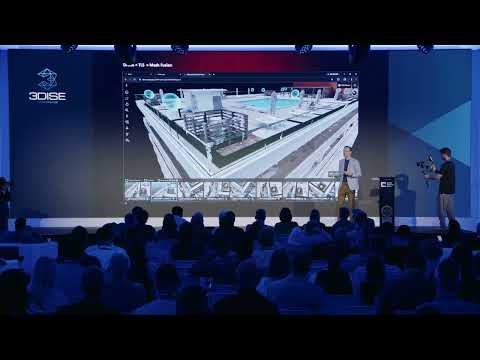

Arash Keissami, co-founder of Nira, explains why the platform streams rendered pixels from the server instead of sending heavy 3D data to the browser, and what that means for sharing reality capture datasets of hundreds of gigabytes or more. Arash shows customer models from infrastructure, film sets and research, and previews point cloud, BIM, API and Gaussian splat support.
“you can upload a 10-terabyte data set and view it on a 10-year-old iPhone.”
“if you can view a, a YouTube video, you can view your biggest dataset in Nira.”
“But if you send me the link, within a few seconds, I'll be able to get and download that data.”
According to Arash Keissami, Nira renders the data on GPU servers in the same data center where it is stored and streams the pixels to the device, so any device that can play a basic video stream can view it.
At the time of the talk Arash Keissami said Nira was getting close to Gaussian splat support and showed a splat file of over four gigabytes loading almost instantly.
Not yet. Arash Keissami said it is one of the most requested features, but latency with server-side rendering and the lack of WebXR in Apple's browsers have kept it from being prioritized.
Transcribed automatically (ElevenLabs Scribe) and lightly edited. It may contain small errors. Click a time to play the video from there.
Arash Keissami: Thank you. So just waiting. Hi, everyone. I'm Arash. I'm one of the co-founders of Nira.
Arash Keissami: I'm visiting here from California. Um, for the past several years, my team and I have been working and focused on a web platform designed to load really large, massive 3D datasets and make it possible to view them on a wide variety of devices. Pretty much all you need is a web browser, and you can access your biggest datasets. Uh, today I wanna share a little bit about why we built Nira and, uh, give you a little glimpse as to what we're doing next. Um, so we...
Arash Keissami: Just a little bit of a background for myself. I started in games. Actually, I originally started in construction, uh, or construction tools, and then I ended up with games, which is kind of like a lifelong passion of mine. And then, um, I wanted to make a tool to help me and our colleagues organize our data. We would make a wide variety of games, and that data would just sit and get lost.
Arash Keissami: So I wanted to make a tool that would let us access that data, annotate it, review it, uh, inspect it, and also organize that data. And, um, so initially, when we built Nira, I catered to that market. Um, and it was, uh, fun to do, but when we started to make Nira more available, uh, we realized that it was mostly being used in, uh, those that were doing photogrammetry work and reality capture-type data. So here you can see, um, some really nice models that we produced, uh, or we got access to, I don't know, five, six years ago. So maybe around the last five or six years, we've been focusing on reality capture data.
Arash Keissami: So here is, uh, something that's more akin to what we actually see more often. Um, so as I said, about five years ago, uh, a lot of our customers were giving us a lot of feedback in terms of the tools they were needing, uh, and the, the features that wanted to supplement some of their reality capture data. So we see a lot of buildings, bridges, you know, a lot of critical infrastructure, and w- we're now focused on basically trying to provide tools to make viewing and accessing this data and all the other tools associated with it, uh, as seamless and as intuitive as possible. Um, the vast majority of our feedback is to just add more supplementary tools. Um, but also it is asked to s- you know, add more data types.
Arash Keissami: So in that particular example, there was orthomosaics and photos. Um, here there is a circumstance where textured 3D models, which again was our legacy, uh, wasn't really satisfactory. When you're doing point cloud laser sca- scan captures, um, it's not unusual to augment that with photos to create a nice detailed model. Uh, but even still, um, sometimes some data doesn't represent well with, uh, with a textured model or a textured mesh. And also, uh, vectorizing a model or vectorizing point cloud data can be quite time-consuming and expensive.
Arash Keissami: And again, the, the main issue is that it just doesn't look great. So here we have an example of a model that kind of didn't, didn't get converted very well into a textured model. So the feedback again was, "Can we add support for more data types?" And that's going to be kind of like our story going forward, is just continuously expanding on, on more data, um, and trying to achieve the same level of quality that we've been known for, for textured models. Um, so a few months ago, we announced support for our point cloud.
Arash Keissami: Um, actually, we do a pretty poor job of marketing, so a lot of our, uh, existing customers didn't even know that was even a thing. Um, so we're grateful to have Ted. He's a master at this, so we're glad that he's joining us to help us with our marketing. Quite frankly, our team is still very small, and we are, uh, just really, quite frankly, dedicated towards, uh, you know, development and tools. Um, so here again is the point cloud dataset.
Arash Keissami: In addition to the point clouds, you also get, have access to your bubble views. Um, so you can view them and, you know, not just the bubble views that are captured with the laser scanner, but some of our customers are creating really, really detailed panoramic images using DSLRs, and you can embed them right into Nira as well. So again, a wide variety of tools that are already part of Nira, but we'll continuously, uh, implement more and more tools here for point clouds. Um, one of the things I often hear from our customers in terms of when they share a Nira link, um, it is like, "Wow." Our customers are just blown away by it.
Arash Keissami: Or when they share it with their clients, the reaction is, "Wow." Um, again, because the focus is always on not only making the, the, the tool as easy and accessible as possible, but also just to make it as visually appealing as possible. You know, we see these very expensive robots, and I hear about these extremely expensive drones and laser scanners. Um, they're expensive toys, and we feel like if you're, if you're spending that much for, for these type of devices, you, you are justified to try to use a viewer that can visualize or t- or make the visuals as good as possible. Um, so this is the technical room.
Arash Keissami: I wanted to also share a little bit about how Nira works. Um, so let's go and talk about, I guess, one of the main problems, which is... Uh, actually, just last night someone asked me, like, "How does Nira, um, render so many triangles?" Um, if you wanna announce who you are, I can... I don't wanna call you out.
Arash Keissami: But it's kind of funny that people really don't know how Nira works, and it's, um, not magic, although we hope- we, we kind of wish it was. But really the, the main, uh, strategy is... I guess I should explain the, the main problem, which we all know, is that, uh, sharing 3D models or even viewing 3D models, even if you have a high-end machine, is very difficult. Um, and so the first bit is we want to create a very, very fast viewer But that's not enough. Uh, so, um, you know, we deal with data sets that are in the hundreds of gigabytes.
Arash Keissami: So again, when you're trying to build a viewer or make that accessible, it's just not very easy to do. Um, just, uh, a couple weeks ago, we had a customer, now that we've added support for point clouds, uh, was telling me that they were doing an 8,000-scan setup or 8,000 scans. Uh, so eight-eight-8,000 setups and each around a gigabyte each. So, you know, you do the math. That's around eight terabytes of data, and that starts to get very difficult to share, as you can imagine.
Arash Keissami: Um, actually, I, I got access to downloading a, a data set that, uh, was just a public data set, and before I knew it, it was like 15 terabytes. I mean, the, the data sets get large. Um, so I even gave up on that. I'm like, "I wanna put this on Nira, but that's just too much to download." So, um, so let me s-step to the next one.
Arash Keissami: So I-- Before I talk about, like, how Nira works, let's just talk about just traditionally what people typically do when wanting to use or share 3D on the web. So I'm sure most of you have heard of WebGL. It's pretty much the standard. Uh, there are several widely used solutions. Pretty much all of them use WebGL.
Arash Keissami: Um, when g- WebGL is, if you haven't... if you don't know, is more or less like the integrated, uh, API or programming language or, uh, programming interface that's implemented into more or less all browsers. Um, I have a lot of experience with WebGL. I was one of the first to start utilizing it way back, I don't know, about 2010 or so. Um, but it's not fun.
Arash Keissami: It's, uh, it's... There's a lot of incompatibility issues. Um, some devices and some browsers don't imple- uh, integrate the, all the, the s- the, the latest and greatest features of WebGL, and it's also just kind of a subset of what you can do when you have access to, uh, the GPU through traditional APIs like Vulkan or OpenGL or some of the other ones that are typically used for, like, video games. Um, so again, we didn't want to build something built on top of WebGL. Um, and quite frankly, the, the platforms that do support WebGL, they, uh, have, uh, challenges with still loading large data.
Arash Keissami: Um, so typically you upload the data to a server, then the data is needing to be downloaded to be viewed. And, you know, if you're uploading something that's several hundred megabytes, that starts to be a trouble. That starts to be a problem. And when you're starting to upload several hundred gigabytes, it becomes pretty much impossible. So, um, most platforms that support WebGL, they usually have some arbitrary size limit.
Arash Keissami: You can only upload a couple hundred megabytes or, you know, maybe 500 megabytes even on their enterprise-level plans before you can't upload more. And that's not a knock on them. That's just the way things work. You don't want to upload more than 700, several hundred gigabytes before, um... or else whoever's gonna be getting that data is gonna have issues viewing it before their browser starts crashing.
Arash Keissami: Um, so aside from that, there are... There's another strategy to fix this or to get around this limitation, and that also uses WebGL, but it's basically utilizing, um, a tiled or hierarchical structure to basically, uh, chunk up the data and make that more accessible. So it's also simila- sometimes referred to as like LODs. Um, this concept isn't new. Um, we did this same thing for when we were making video games.
Arash Keissami: Um, and there are many different implemen- implementations. But again, the, the general concept is you kind of chunk it up, and then as you navigate through the model, you're able to load and or fetch and, and, and, and re- you know, remove data so that things can be accessible. Um, the problem, as you can see here, is that there are some pretty big trade-offs. Like, first of all, you kind of need a fairly fast connection to get access to the data. Again, the, the data with these other, these WebGL platforms is sitting on some server.
Arash Keissami: Could be a few miles away or several hundred miles away, and it has to travel to your computer. And even if you have a fast internet connection, you could have a 10-gigabit internet connection, you're still having to depend on the server to also provide that data at some kind of a reasonable speed. And then even still, you have the challenge of whether or not your computer, uh, has the graphics power to visualize that data. Um, so in a circumstance like this, uh, no knock on Potree, but that's one of the more popular viewers that are available. A lot of the platforms utilize it.
Arash Keissami: It's an open source platform, great technology, but it's kind of limited with what you can do with just traditional client-side rendering. Uh, that's another phrase that's often used as well. Um, one of the other biggest problems with this is that it's extremely easy to scrape or, or steal essentially the data. Um, so whatever platform you might be using, they might talk about all kinds of security and everything else. But if you send me the link, within a few seconds, I'll be able to get and download that data.
Arash Keissami: It's a pretty trivial thing to do. So there's no amount of security that will never be a solved problem. That is, uh, an inherent problem with client-side rendering. Um, so let me jump to the next slide. Um, so Nira uses something very different.
Arash Keissami: So, um, we took a very different approach. Uh, we use something typically referred to as either server-side rendering or sometimes referred to as pixel streaming. Um, the way it works is pretty straightforward. Uh, the data is stored and rendered more or less locally, kind of within the same data, data center. So instead of having to send the data to a, you know, a device like your laptop or phone or whatever the case may be, um, it's basically just transmitted to the s- the server that's has a, a GPU, uh, in it, and it's rendered right on the server.
Arash Keissami: And then what we do is we render it using our custom, uh, uh, rendering tool, and we stream the pixels to your device. Um, so it's, uh, actually becoming a more common strategy for gaming studios to use this, and we more or less took that strategy for delivering these large data sets. The-- One of the best advantages of this is that, first of all, it makes your data extremely accessible. Um, again, you can upload a 10-terabyte data set and view it on a 10-year-old iPhone. In fact, your iPhone or any mobile device, quite frankly, will have the exact same viewing experience as, you know, 10, $20,000 workstation.
Arash Keissami: It really just needs to be able to view a basic five-megabit video stream which You know, if you can view a, a YouTube video, you can view your biggest dataset in Nira. Uh, let's see, what else? Um, so as mentioned, we're now very much focused on the reality capture space. So if you've got reality data, that is our focus. Um, that's what our customers are asking for.
Arash Keissami: Um, here is, uh, an example of, uh, a model that was captured using a combination of a laser scanner. So this was the RTC 360, um, and just a drone, uh, DJI, uh, Mavic 3. Um, and using the combination or sometimes referred as a hybrid model, you're able to create these very, very detailed three-D models. Um, you can also see, uh, we have some annotation tools or, or markup tools so you can find issues, uh, you can write up descriptions, we can generate PDF reports. You can also do some basic measurements, which I think I do here in a second.
Arash Keissami: Um, by the way, if I process this model, and if you're curious how I did it, um, I'm going to be creating a tutorial on this particular dataset. It's provided to us by, uh, one of our customers. He was very generous, uh, Zachary Ryder, and he's been, uh, generous enough to let me use that data and also make it available to download so you can create, uh, similar models in whatever photogrammetry tool you want to use. I actually used RealityCapture for this, one of my favorite photogrammetry tools. They just happen to be a sponsor here.
Arash Keissami: Um, but Nira is compatible with more or less all the photogrammetry tools as well. Um, here's another example. This is maybe back in the entertainment space, but that's okay because reality data is used in more or less all, all, um, markets and industries. Um, so we are, we're seeing a lot of customers come from a wide variety of different, um, markets, and we are open with those that were kind of our legacy customers and telling them like, "Hey, our focus is now on reality data." And they're like, "Oh yeah, that's fine.
Arash Keissami: We still need that." Um, so we have customers in a lot of different markets. And here you can see, uh, the... some of the... This is an example of a company, uh, in Madrid.
Arash Keissami: They're called Paris Digital, and they have, uh, literally millions of costumes stored in a warehouse. They gave me a little FaceTime tour of it. It's pretty amazing. Um, and they basically have, uh, um, uh, just a, a scanning setup where they capture it and then now they can share it with their clients. Um, here's a model from, uh, one of our best friends at Overhead4D.
Arash Keissami: Um, I say best friends because Tomas and, uh, Michal have been very helpful with answering, um, a lot of our q-questions, uh, on their journey. So again, when you're coming from a background in entertainment, it's, uh, this whole world. I feel like I started over with my career. Um, and this whole world is, uh, is, is there's a lot of lingo and a lot of technology and the stuff is not cheap. And so getting access to data was not easy, and they've been super, super helpful and generous.
Arash Keissami: And quite frankly, uh, I'm sure even some of you in this room, I've directed you towards Overhead4D because they provide some of the best training you could get. So if you're always curious about how to create really nice models or, or datasets, they can pretty much answer all of your questions. Um, so thank you. And by the way, great job with the first year. This is...
Arash Keissami: You guys are knocking out of the park, and I'm very impressed and, uh, and, um, same to, where is he? Matthew and the RCN team. You guys have done an amazing job too. So hats off to you guys. Uh, let's see.
Arash Keissami: Um, here's, uh, another one again from the entertainment space. This was a capture of the, uh, Netflix "Barbarian" set. Um, uh, digitizing a set like this allows for a director to plan their shots remotely. Um, so you could, you know, when you have inspiration, you could be in the shower, you could be, uh... And I'll admit, I sometimes bring my phone to the shower sometimes.
Arash Keissami: But you can be in bed and sometimes you get an idea and, you know, if you need to get up to be on a high-end workstation to get access to a dataset, you kind of lose your idea. Especially as I get older, I'm forgetting what I think about as I move to the next room. Like, what did I just think about? It's, uh, there's actually a, a phrase for this. I think it's...
Arash Keissami: I forget what it is, but man, it's... I have to sometimes write down something before I leave into the next room or else I'll forget it. Um, but anyway, this, this, again, this dataset was a-another com-combination of a laser scan and photos to create a very detailed model. I don't think I showed it in this video, but there was like a little dead mouse in one of the, in the little trenches. I probably purposely kept it out, but it's kind of funny that you can find stuff like this and, and it's pretty highly detailed.
Arash Keissami: Um, so let's see. Uh, you guys might recognize this cell tower. It's actually something I processed, um, and I uploaded to LinkedIn, I think on Christmas Eve. Bad idea. Uh, for whatever reason, the, the LinkedIn algorithm gods basically made this very popular.
Arash Keissami: Ended up getting like half a million views and pretty much ruined my Christmas. I was looking forward to a little break without having to answer emails, and it just turned into the exact opposite. So, um, yeah, it's just, uh, we appreciate the interest, but it's kind of getting, uh... it was, uh, especially at that time was, it was becoming overwhelming and, and the last thing I like to do is go to bed with unanswered emails. But that is something I'm having to get used to.
Arash Keissami: Um, which by the way, we're very happy to have Ted again, uh, so he can help with this because quite frankly, um, we get a lot of customers asking like, "How do you create such really cool models?" And part of that process is utilizing a lot of the photogrammetry tools, and they're great, but they can take some time to learn. Um, and we usually help them with that too. Um, so but in this particular example, the reason it became so popular is because you're able to now represent a lot of the details in the three-D model with, uh, with the high resolution data that you can create with these photogrammetry tools and then upload to Nira. Um, there is really no limit to how much texture detail you can have or points or, or any of that stuff.
Arash Keissami: Here's another, uh, capture or yeah, basic dataset from Michael. Thanks again, Michael, for this. Or Mikhail. Sorry, I'm still learning how to pronounce your name. Um, so thanks and, and, and here as we're adding support for point cloud data, um, we're working on improving our support for, for BIM data and all, again, all the associated data that is relevant to the point cloud datasets.
Arash Keissami: Um, so, um, you'll soon be able to upload. I'm surprised how big some of these IFC files can get, but multi-gigabyte datasets and be able to get access to them and view them at very high quality. Um, in addition, we're, you know... I already mentioned that we have support for panoramic images, um, but now you can integrate the BIM data. We'll have analysis tools and also be able to integrate IoT-type data, stream that in, uh, through our API and start to create your own interactive applications.
Arash Keissami: We already have a viewer API, um, and so if you S- use Nira and get access to it, and you're like, "Oh, I wish it could do this. I wish it could do that." It actually already has an API, and you can extend it on your own, and we can help you, uh, through that process so that you can create your own custom applications. This is basically just a prototype that we put together, where basically when you click on the point cloud dataset, it finds the associated m- uh, IFC, so it kind of helps you segment portions and then you can more or less tag or annotate them and, uh, and save it even on your own datas- database or access it, uh, within your own database. So you don't have to store everything all on Nira.
Arash Keissami: Uh, uh, we're going back to the cell tower. Uh, we decided to create a BIM model for this too, just why not? Um, again, the, the goal is so that we can, um, highlight the, uh, the, the, the BIM elements and get the associated metadata to that. Um, this, this model got a lot of attention, as I mentioned, but when you create something, you, you notice problems. So here you can see there's, like, a chunk of the, the model missing.
Arash Keissami: There was actually a cable there, but it went missing. Um, so I'm excited to share that we are getting closer to having support for our Gaussian splats. It's obviously the, the thing that everyone wants, and it was certainly something that our customers were asking for. So the cool thing about Gaussian splats is that it can do many things that textured meshes and point clouds cannot. Um, they are really great with rendering, like, thin cables or railings, hair, fur, uh, and, and just actually even giving you backgrounds of your asset so you get a better context as to the area that was captured around it.
Arash Keissami: Uh, here's another Gaussian splats. Uh, this one was provided by Tan. He cr- he, uh, pro- captured this using the XGRIDS, uh, laser scanner. Super sco- super cool scanner. Um, but as you can imagine, with a lot of reality capture devices, it can get quite large, right?
Arash Keissami: At least the data can get quite large. Uh, this particular file was around four-plus gigabytes, um, but it loads pretty much instantly. Um, this is just the biggest one I have. If any of you have anything bigger, please do send it to me. Uh, we'll probably be able to support unlimited size point, uh, uh, uh, uh, splats pretty soon.
Arash Keissami: Um, by the way, if, if you remember in the beginning, the tagline that we have for Nira is, uh, "Polygons, uh, points, photos." Uh, uh, "A billion polygons, points, photos in your pocket." So three things that start with P. I'm a little bit disappointed Gaussian splats doesn't start with a P, because that would've been nice. Um, maybe we can use pixie dust.
Arash Keissami: That was... Uh, let's see. So here's, uh, since Earth Day, I don't know if you guys know this, but a couple days ago it was Earth Day. Um, and I noticed in this particular part of the world, less in America, but in this particular part of the world, they were very conscious about Earth Day. Pretty much all the straws were not plastic, which I appreciate.
Arash Keissami: I'm glad you guys are a little bit further along with it than we are. Um, although we use some of these non-plastic straws in, in the US too, but, um, I, I appreciate all that. But anyway, um, this was a capture that was done for the University of San Diego. Uh, they were exploring various, uh, devices to capture, monitor, and measure, uh, coastal erosion along the Pacific Coast. Um, I think Nira is the only platform that lets you measure volumes along, uh, vertical structures or facades.
Arash Keissami: Uh, so that's kind of a nice unique element to Nira as well. Um, so anyway, this is just the sample of the various use cases for Nira. There's, there's plenty more. I'm sure I'm forgetting that, uh, some of them. Um, but, uh, we love talking to our customers, seeing what and how they do things.
Arash Keissami: Everything you upload in Nira is extremely private. We don't see or know what you're uploading. So if you do upload stuff, that's cool. Please do share it with us. We'd love to know.
Arash Keissami: Um, and currently, we have customers on every continent. Uh, uh, that's... Yes, that does include Antarctica. Um, actually, that they are capturing, um, using drones, which is actually kind of surprising they can do that in the cold weather there. But they do it to monitor, uh, penguins colonies, uh, which is fascinating.
Arash Keissami: So it's not just buildings and bridges. There's a lot of things that, uh, need to be captured. Um, actually, I just had a meeting with another organization that used Nira to count puffins in the UK. Um, uh, and you know, another, uh, company that does... that tracks and monitors invasive floral.
Arash Keissami: I think they were in the Netherlands, which is just fascinating. Who, who could imagine flowers being invasive? So I'm not buying flowers anymore. No, just kidding. Um, anyway, I love our customers.
Arash Keissami: I love what they do. Um, my time is up. Thanks for having me.
Host: Great job, Arash.
Arash Keissami: Thank you. Appreciate it.
Host: Amazing. So plenty of questions-
Arash Keissami: Oh.
Host: Even for you towards the end of the day. Let's get into them. Uh, let's bring, let's bring them on the, on the screen over there and over there. Uh, a couple of questions that related to the VR/AR support. Can you project these models to the AR/VR?
Arash Keissami: Not yet. Uh, it is something that's often requested. Um, we just haven't been prioritizing it yet. It is probably one of the, uh, it's one of the most requested features that we haven't prioritized, only because we're not convinced that through server-side rendering, you can get the latency, the latency low enough where it doesn't make you sick. So it's...
Arash Keissami: There are, there are ways of getting around that, um, and we're looking into that. Another big problem with, uh, AR and VR is that there hasn't come a clear consolidation in terms of standardization. Apple, for whatever reason, doesn't want to adopt WebXR into, uh, web browsers. And we could certainly develop a native application, um, but we think that we-- it just makes things a little bit less successful. So we'll look into it.
Arash Keissami: We actually did already develop an AR application. We demonstrated it around six years ago. Uh, but... And we were hoping that Apple would adopt, uh, WebXR so that we didn't have to write multiple variations of it, but it hasn't happened. And again, because of our team size being still small, we have to very, be very meticulous about what we develop.
Host: Got it. Let's take one more.
Arash Keissami: Sure.
Host: Would it be possible to add objects to an existing model, cars, people, et cetera?
Arash Keissami: Yes, you can do that. Uh, inside of Nira, if you have an existing dataset, you can just upload stuff into that. Um, or you can just use a, a wide variety of desktop tools to create a nice curated, uh, asset and then upload it all together in one. But there's no, there's no limit to when you can upload data to an existing asset. I hope that answers it.
Host: Perfect.
Arash Keissami: We'll see.
Host: Well, ladies and gentlemen, let's give it up for Arash one more time. Thanks so much.
Arash Keissami: Thank you.
Host: Thanks so much.
Arash Keissami: Take this back.
Host: Oh, you can take that one.
Arash Keissami: Okay.

Co-Founder @ Nira.app
At Nira.app, our team is revolutionizing the organization and collaboration of large digital assets, leveraging over two decades of experience. My expertise lies in creating sophisticated platforms that cater to the complex needs of site inspection, media review, and data analysis.