

Johannes Hotz, business lead for the BLK ARC at Leica Geosystems, demonstrates autonomous mobile scanning with the BLK ARC mounted on Boston Dynamics' Spot, live on stage. Johannes explains when a robot makes sense (places dangerous for people and repetitive scans), how path recalculation, no-go zones and docking stations work, and shows customer cases from construction progress checks to facility management.
“You want to remote control a robot in an environment that is dangerous for a human.”
“Sensors, laser, um, vision, glass is not existing.”
“So you can always do a cloud-to-cloud comparison, show the differences, and then only model the differences.”
Yes. Johannes Hotz described scanning a burnt-down apartment complex in Essen with Spot and the police after structural engineers barred entry; long-range work needs mesh radios.
According to Johannes Hotz, once Spot knows the path it is almost a single click to a mesh or point cloud; autonomous exploration of an unknown building is still the tricky part.
Johannes Hotz said the battery lasts about 80 to 90 minutes, so overnight missions are planned from docking station to docking station where Spot recharges.
Transcribed automatically (ElevenLabs Scribe) and lightly edited. It may contain small errors. Click a time to play the video from there.
Johannes Hotz: Um, good afternoon, everyone. Great to see you again. Um, thanks for the clicker. Now I'm big trouble. Um, BLK Autonomy.
Johannes Hotz: Um, as I mentioned before, and maybe for those, um, who have not seen the panel discussion that I jo-- where I joined, um, I look after mobile scanning. And mobile scanning, what is the advantage of mobile scanning? Very easy and obvious. You capture while you walk. So while you walk could be a human, could be my-- one of my favorites, honestly, a golf trolley, where I can walk simply through an environment and scan, or I can do it like that with a Spot or any other robot, of course, as well.
Johannes Hotz: Of course, it makes sense that no one is following a robot and scans. Here we talk about autonomy, so we can train the robot that he repeats a route constantly. Um, oh, wrong side. Stupid. Um, a three-d laser scanner equipped with three hundred and sixty degree cameras cannot only scan the environment.
Johannes Hotz: The cameras cannot only, um, colorize the point cloud. They will also allow to make a walk-through. Um, here, this is a video we done in a Hexagon lab, a production location we have. Um, it's always hard to get videos out of production locations, so we took our own one. This was a fully autonomous path where the robot was following and repeating.
Johannes Hotz: This one, another one, this is the Citadel de Besançon, a World Heritage location in France. You see the agility. I just showed it before with Spot when I walked upstairs. This is on construction site. Construction site, we had the discussion before on this panel discussion where we saw-- said, um, safety for workers.
Johannes Hotz: We have customers that scan constantly and every day escape routes. Uh, you know, the security paths that they are not blocked. This happens on construction sites, this happens in automotive factories. The robot just walks through, sends the data to the cloud, compare it with a model and says there is a clash of the escape path or not. Sounds stupid, but the customers say to me they save thirty-two hours per week in men.
Johannes Hotz: Thirty-two hours. There was one person constantly doing it manually, and now they have still work to do for processing the data. They are down to eight, a massive decrease. And the risk is insurance. So if something happens, people can't get out or are blocked, insurance will not pay.
Johannes Hotz: All right, um, next topic. About me, I s-- I introduced myself in the morning already. I don't want to bore you. Well, one thing, I have a huge passion for surfing. I was last week in Portugal.
Johannes Hotz: Became pretty relaxed, still relaxed. The problem is I am living in Switzerland. Does anyone have a job next to an ocean with a coast? No, just kidding. Um, it's hard, but you know, pla-planes, cars are existing, but that's my biggest passion.
Johannes Hotz: So you see the thing-- I did not a photo of the scan of the QR code from my talk before. Um, that was over my when-- I get out when he showed the binary code. That was too much. Come on, honestly, who was also lost there? Uh, th-thank you for your honesty.
Johannes Hotz: I was out. Okay. Well, um, as I said, when you scan while you move, you have the advantage to be fast. You have the advantage to have a complete point cloud. Who knows scanning very well from a-- with a terrestrial laser scanner?
Johannes Hotz: Eh? The problem is scan shadows. With mobile scanning, we avoid them because you get from everywhere a little bit angle to a view to something, and this simplifies the scanning routine. So if Spot walks, the scanner always sees something. So currently this monitor blocks something, but now he sees it.
Johannes Hotz: Next one. Um, as I said before, um, the, the, the scanner what we are utilizing on Spot has big advantages. So it's not only on Spot, but I have to admit, um, forty percent, forty-five percent of all BLK ARC sold are equipped on a Spot dynamic Spot. In the pre-- in, in the panel discussion, there was a question, how many, um, construction sites are constantly scanned with Spot and the BLK ARC? I'm aware of currently twenty-five in mainly Europe, Malaysia, hmm, big giga factories, and in the US.
Johannes Hotz: So twenty-five, that's the answer. What are currently daily scanned. It's not huge. But it's a start. Um, then you can put it on a pole.
Johannes Hotz: I did a very nice scan in a, in a sewer, in a manho- in a sewer, where I used this manhole. Very good, interesting. We have quite a few customers who put the ARC on a boat. Um, I got a call this morning from a customer who asked, what if he gets submerged under the water? I said, "Well, then it's broken."
Johannes Hotz: Mm. So on the boat, be aware, submerging will not be good for the scanner. But you can put it on the pen, on the backpack. You can-- and then walk through an environment, um, revealed robots, shaft scan, or my favorite, um, scan cart. But let's go back to this robotics.
Johannes Hotz: Why using robots for m- laser scanning? This setup, the Boston Dynamics Spot, the Core IO, so the brain, the ARC is about hundred seventy, hundred eighty thousand euros. So it's not cheap. But why do you want to utilize that one? What is the benefit?
Johannes Hotz: The benefit is, in one case, autonomy. Um, you do teleoperation or remote control like you do it basically with a toy. So you have cameras that show you where you walk, which shows you here on the display. Um, you have the option also to see the point cloud live. That's what we are releasing in our app in the next days.
Johannes Hotz: With that, you have the depth information. But why do you want to remote control a robot? You want to remote control a robot in an environment that is dangerous for a human. I always give the example, a contaminated area of a nuclear power plant. Obviously, difficult for humans.
Johannes Hotz: Unfortunately, I'm not allowed to share you the data. We are about forty, fifty power plants which are daily in operations, um, with Spot and ARC and the gamma radiation sensor. Here, this is a tunnel from a mining. And in mining, for example, it's sometimes very dangerous for humans because the ceiling is not reinforced, so rock falls. So y- there you send the robot in, and you control him from a safe location.
Johannes Hotz: This can work with mesh radios over hundreds of meters, so you don't have to follow. Another one, this is, uh, quite interesting. This is a power distribution. So it's a substation. Here we have planned with GPS waypoints and let the Spot walk through these dangerous environments.
Johannes Hotz: This is a two hundred twenty kV, um, substation. Um, if the, um, light bulb jumps over you, even from me is a little ash left. So here you see the path was planned. Collision avoidance works. That it gets also quite nice.
Johannes Hotz: Um, if you-- if Spot walks towards to you, he will bypass me. So I'm not doing anything, he will bypass. So his collision avoidance allows him to bypass things. He will not stop if I jump in front of him. So I was in exhibitions where people really jumped in front of him and got stuck.
Johannes Hotz: It's the same with a car. Uh, there is a little bit of reaction time. So he is not-- Basically what he does not do like cars, we are not calculating the trajectory of a moving object that goes in front of him. So only static ones. And yes, touch him.
Johannes Hotz: He is pretty stable. So he will do things. Pl- uh, please don't kick him. Maybe you have seen the YouTube videos where someone kicked him. Um, please don't do it with mine.
Johannes Hotz: So next one. So one is, as I said, dangerous for humans. The other one is repetitive scanning. So if you have to scan the same location, the same object again and again and again. This does not mean necessarily that you have to do it twenty-four seven every single day, but maybe once a week, once a quarter, uh, twice a year.
Johannes Hotz: Even then, the robot will not forget his path. So you train him the path, you give him the, his trajectory to walk, and then he will repeat this path again and again and again. And this can be done today and in half a year again. So if you want to scan again, the same thing, this is also good because it's less time. Humans are not involved.
Johannes Hotz: It's less-- It's expensive on one hand, but less expensive than constantly, um, scanning. I-- Would be nice to guy-- ask the guy from Škoda how much they spend a year on scanning services, huh? It's a couple of hundred thousands, I'm, I would assume. So here, a good option. And traditionally, it's a lot of manual things.
Johannes Hotz: Here with that solution, here on top, this is the brain. As I said, here on top, I have not mentioned, there is an, uh, a 5G antenna, so you can directly stu-- load the data to the core and send it to the cloud, where the datas get processed in the Reality Cloud Studio. Maybe some of them you have the session with my colleague, um, where you see of that. So directly push, and they will automatically processed. Um, now, a little bit of autonomy.
Johannes Hotz: So the situation what you have seen before was this empty room. Now, when we plan a road to go from here to here, now it's blocked. What happens? The blue thing is the walls, what he sees in his live scan. Uh, the gray one, sorry, and the blue one is his model he has to-- he used before.
Johannes Hotz: So at-- basically what happens, he always recalculates his path. So the red one that you can see here is a no-go zone. So one thing he doesn't like is glass. So if you have a beautiful glass elevator, he will run into it. Sensors, laser, um, vision, glass is not existing.
Johannes Hotz: So therefore, you can define no-go zones, and then he will bypass it, and he re- always recalculate, recalculates the path. So therefore, even in very difficult environments, you can do proper things. And he will always find a way back to his path of origin. You're seeing here on the lower part, that's a docking station, and also very important if you want to autonomy. Um, battery life is about eighty to ninety minutes.
Johannes Hotz: And you want to run him overnight, hmm. So you can plan from docking station to docking station, and then he will recharge, and once he's full, he will continue his scanning path. That's a also quite nice one. That is an example from, from, um, a customer in Spain. They do night scans.
Johannes Hotz: Construction site, and they want to c-compare progress, um, and they also want to be-compare, um, the, um, as-built status. So is the model matching with the reality or are there deviations on the pillars? So you can see it was pretty dark at night. So he, he walks overnight the planned path. Then in the evening, the-- once he's finished, he uploads the data.
Johannes Hotz: The guy comes in the moring-- morning, aligns the point cloud with the model. That's a manual step. And then you can see how this, um, comparison looks like. Uh, so you, uh, do a simple transformation with, um, three identical points, transform it, and then you can see in the point cloud how things are looking like. So you see the floor is on the right level.
Johannes Hotz: But here you see on one pillar which is maybe not perfectly aligned. So this is, um, the green one, the gray o-- the ori-- uh, the pink one, you will see later a deviation element where it's misses the difference to the, um, uh, planned model. Next one, facility management. Um, one of the key elements is to constantly update the digital twin of your facility. For that, people, and this is for example, a customer in the automotive, um, they scan w-- twice a year the production halls.
Johannes Hotz: For that, they bring the Spot into the facility, they have the docking stations placed, and then it will go take them about a week to scan one big production hall, and then they move to the next one, to the next one, to the next one. And basically, once they are finished in the locations, for example, in Germany, they start again in the next one. Big time savings. Big time savings. This is a, a chemical plant, again, fully autonomous scanned.
Johannes Hotz: Unfortunately, the video is a little bit cracky here. Um, but this gives you an idea what you all capture with a, with a very easy and straightforward, um, mobile scan. Um, you have the entire ceiling elements. The BLK ARC is a full three sixty scanner. So every second, he scans full three sixty horizontal, as well at two hundred seventy de-degrees.
Johannes Hotz: So you get always the full ceiling, the ground, and the walls as well. And in this case, what you can do with the data, you can mesh them, so you get a, a, a, a lightweight model, and then you can also model it. So out of the point cloud, you can create then a model with our software in order to get the first step into the full digital, um, twin. And of course, you don't do that one every time, but if you see that the pipes are in new positions, you remodel them, um, only by the differentiations. So you can always do a cloud-to-cloud comparison, show the differences, and then only model the differences.
Johannes Hotz: With that, um, I have two minutes left, um, and time for questions, if there are any. So far, not.
Host: Johannes.
Johannes Hotz: Appreciate it.
Host: Well done. Well done. Really, really super fascinating. And actually, there are-- There, there is a list of questions that people submitted once again.
Johannes Hotz: Okay.
Host: So let's just get them back on the screen, please. So there is a cheeky one. Can the dog do a backflip?
Johannes Hotz: Um, this one not. I can tell you a story. I like stories. Um, and should I say who that was? Uh, they are using a-another robot dog, Unitree.
Johannes Hotz: I'm not sure if you know that one, a Chinese one. Um, the Unitree Go2 can do a backflip. Um, it's the Queen's University of Belfast. Um, I never said that. They called me, they crashed their ARC.
Johannes Hotz: I said, "What happened?" "Uh, someone did a backflip with the ARC mounted on it."
Host: Mm.
Johannes Hotz: And since this is a payload and the Unitree cannot register payloads, so on the Spot, you restrist-register a payload. It knows the weight, his height, so he will calculate everything accordingly. But the Unitree can't, so they did a backflip, and he was land-landing on his back. So no, it can't, and I'm happy that he can't. Next one.
Host: Cool. Next one. Exactly. So how close are we to push a button scanning workflows with no operator needed?
Johannes Hotz: Good, good question. Um, um, I would say once the Spot knows the path, we are pretty close. So to get a mesh or final point cloud out of it, it's, it, it's existing almost. Really just a little click. The challenge is, as of yet, that Spot needs to know the environment he w- walk.
Johannes Hotz: In, in robotics, there is one synonym which is called exploration. So I would send Spot in here, start scanning, and once you are finished, tell me. This is exploration. So he will explore the path around the entire building. People say my lawnmower can do it.
Johannes Hotz: Yes, but I don't want to scan stupidly wrong things the whole time. Uh, the, the lawnmower has fuzzy logic, so he drives forward, backward, and finds the path. He knows the boundary and gets it. But we don't-- We want to have intelligent scans. We have proper sights.
Johannes Hotz: So this is a little bit tricky. So once he knows the location, we learn the path. From there, we are pretty close to one push button. The other one is a little bit more tricky.
Host: Got it. Let's take one more question. Is it possible to use this robot to sc- to scan dilapidated buildings, somewhat dangerous for people?
Johannes Hotz: Uh, my English is not that good. Dilapidated means?
Host: Uh, I think it's somewhat dangerous for people. Anybody who wants to elaborate on that?
Johannes Hotz: Is it-
Host: Xenia?
Johannes Hotz: close to collapse?
Host: Perfect. Reclining.
Audience: Reclining.
Johannes Hotz: Okay. Um, the-- Yes, absolutely. Again, a story . Six seconds, um, I-- there was a big fire in, in, in Germany, in Essen, where a whole apartment, um, complex was burning down. No one was allowed to enter.
Johannes Hotz: Luckily, no one died, um, but hundred twenty people lost their homes. So the static boys, um, the structural engineer said no one can enter. So there was-- we went in with Spot, with the police, and we did the scan of this entire ruined, burnt-down building. So yes, absolutely, you can go there. You need mesh radios for long range supp- um, communication.
Johannes Hotz: But if you have that set up, no problem.
Host: Can you talk about money, Johannes? The very last one. What is the ballpark cost full-time deployment or service-based per-
Johannes Hotz: Whoa
Host: square meter based?
Johannes Hotz: Ooh.
Host: Can you reveal the, the cost?
Johannes Hotz: Square meter. No idea. The ballpark, as I said, is you have to, yeah, with software, education, own resourcing costs to get up to speed, is this set up two hundred K.
Host: Mm-hmm.
Johannes Hotz: And then from there onwards, it costs you nothing because no labor is almost required, huh? But the square meter, I can't say. Sorry.
Host: Mm-hmm. Ladies and gentlemen, let's give it up for Johannes and the Spot. Jesus.
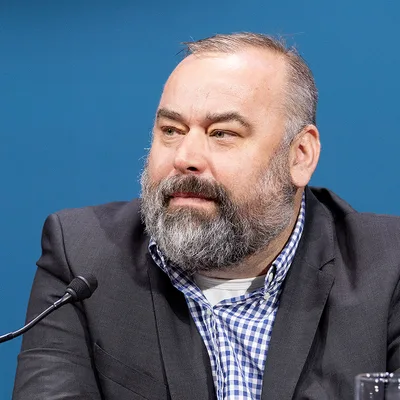

Business lead BLK ARC, LEICA Geosystems, part of Hexagon
With more than two decades in the surveying industry, I have gained a deep understanding of global business development, partnerships, sales enablement, and marketing strategies. I am passionate about educating the community on the benefits and value of mobile scanning technology.


